The Small Label That Can Protect a Big Brand
A customer picks up your product from a retail shelf.
The bottle looks right. The packaging looks familiar. The price looks believable.
But then they notice one thing.
A shiny hologram label that changes colour when the product moves.
That small detail does more than improve the look of the packaging. It tells the buyer, distributor, retailer, and inspector that the product carries an added layer of protection.
That is why many brands today work with hologram label manufacturers when they want packaging that looks premium, feels authentic, and becomes harder to copy.
But what exactly are hologram labels? How do they work? And when should your product use them instead of a simple printed sticker, barcode, or tamper seal?
Let us break it down.
What Are Hologram Labels?
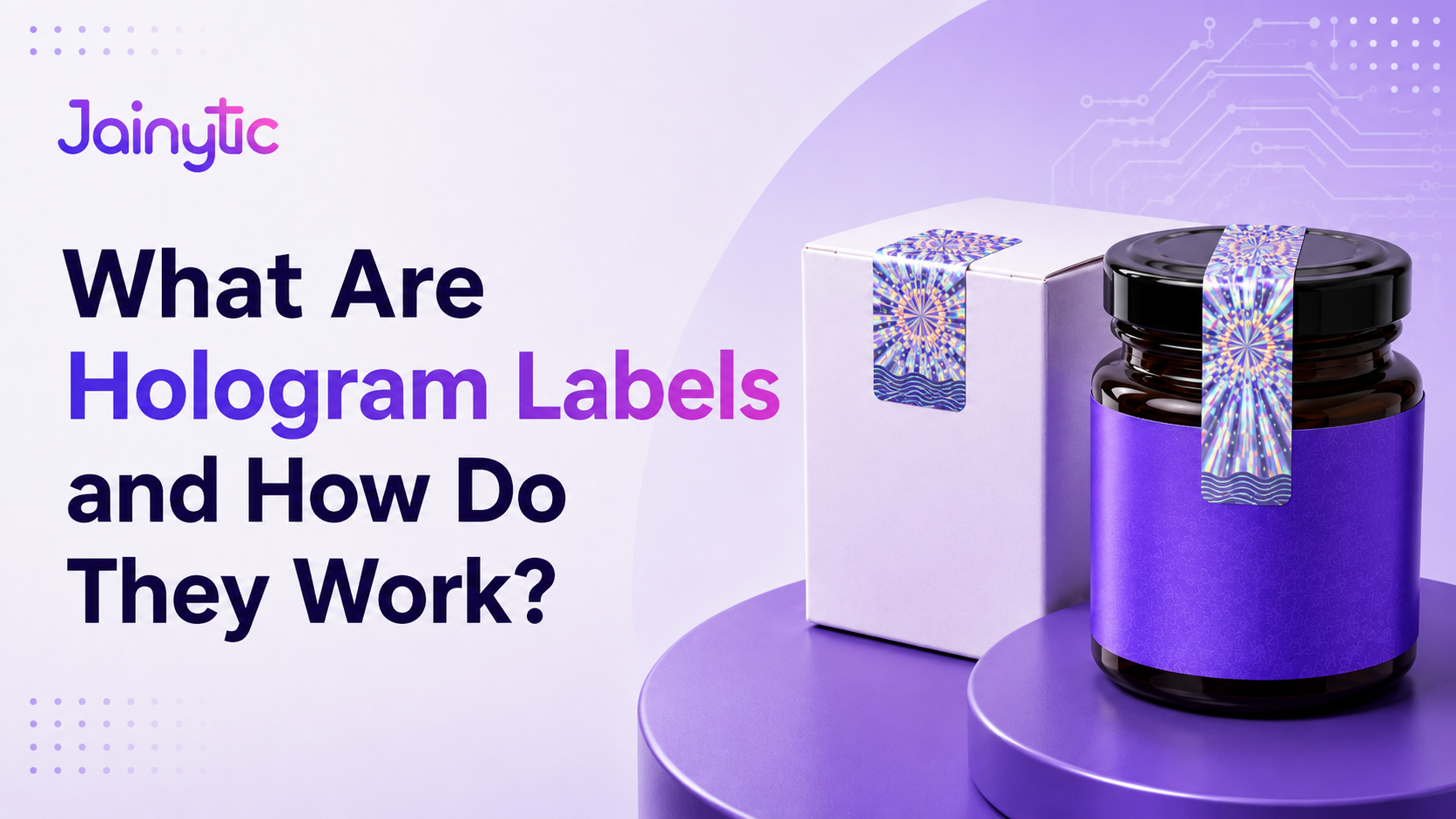
Hologram labels are security labels that use holographic effects to create a three-dimensional, light-reflective appearance. Unlike regular printed labels, they are made using optical patterns that shift, shine, or reveal different visuals when viewed from different angles.
This makes them useful for product authentication, brand protection, warranty sealing, document security, and anti-counterfeit packaging.
In simple terms, a hologram label is not just decoration.
It is a visible security signal.
Customers may not understand the full technology behind it, but they understand what it communicates: this product has been protected, verified, and professionally packed.
Why Brands Use Hologram Labels
Counterfeit products are no longer limited to luxury items. Today, duplicate packaging affects pharmaceuticals, cosmetics, automotive parts, electronics, liquor, FMCG products, agrochemicals, and industrial goods.
In many cases, counterfeiters do not need to copy the product perfectly. They only need to copy the outer packaging well enough to confuse the buyer.
This is where hologram labels become important.
They add a layer that is difficult to reproduce through normal printing. Security holograms create optical effects that are hard to copy with conventional print methods, which is why they are commonly used for brand protection, seals, certificates, and product packaging.
For manufacturers, hologram labels help solve three practical problems:
- They make genuine products easier to identify.
- They make packaging harder to duplicate.
- They improve the buyer’s confidence at the point of purchase.
How Do Hologram Labels Work?
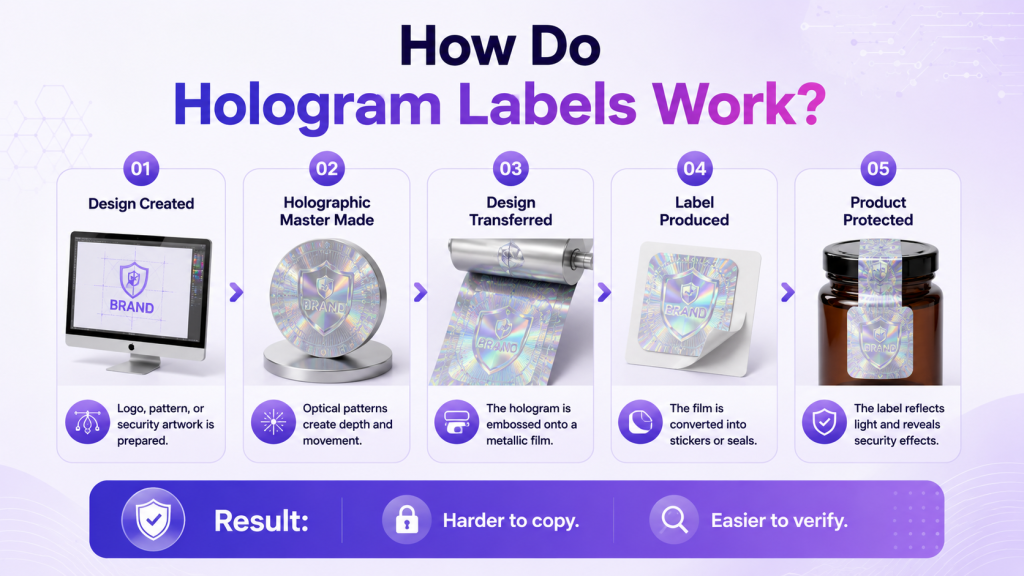
A hologram label works by controlling how light reflects from the label surface. Instead of using ordinary flat ink alone, holographic labels use micro-patterns, metallic films, and optical structures that bend and reflect light in different ways.
When someone tilts the product, the hologram may show movement, depth, colour shift, hidden text, logo effects, or layered visuals. These effects are created during the hologram origination and embossing process.
Here is the simple version:
- A brand’s logo, pattern, or security artwork is designed.
- The holographic master is created using optical or digital technology.
- The design is transferred onto holographic film.
- The film is converted into labels, seals, or stickers.
- The final label is applied to bottles, cartons, containers, pouches, tags, or documents.
The result is a label that cannot be recreated accurately with a standard printer or basic sticker machine.
Common Security Features in Hologram Labels
Not all hologram labels are the same. A basic hologram may only offer a shiny visual effect, while a high-security hologram can include multiple authentication layers.
Common features include:
- Custom brand logo or product identity
- 2D or 3D holographic effects
- Micro text that is difficult to copy
- Hidden images or covert security marks
- Tamper-evident adhesive
- VOID effect after removal
- Serial numbering or barcode integration
- QR code authentication support
This is why businesses often look for experienced hologram label manufacturers rather than choosing generic sticker suppliers. The security value depends on the design, material, adhesive, finishing, and application method.
Hologram Labels vs Regular Labels
A regular product label mainly communicates information. It carries the brand name, product details, ingredients, instructions, barcode, and design.
A hologram label does something different.
It protects identity.
That does not mean hologram labels replace regular labels. In most cases, they work as an additional security layer on top of the main product label or packaging.
| Feature | Regular Label | Hologram Label |
| Main Purpose | Branding and product information | Authentication and security |
| Visual Effect | Flat printed design | Reflective optical effect |
| Copy Difficulty | Easier to duplicate | Harder to reproduce |
| Tamper Evidence | Limited unless specially made | Can include VOID or destructible layers |
| Best Use | Everyday packaging | Brand protection and anti-counterfeit packaging |
Types of Hologram Labels Brands Can Use
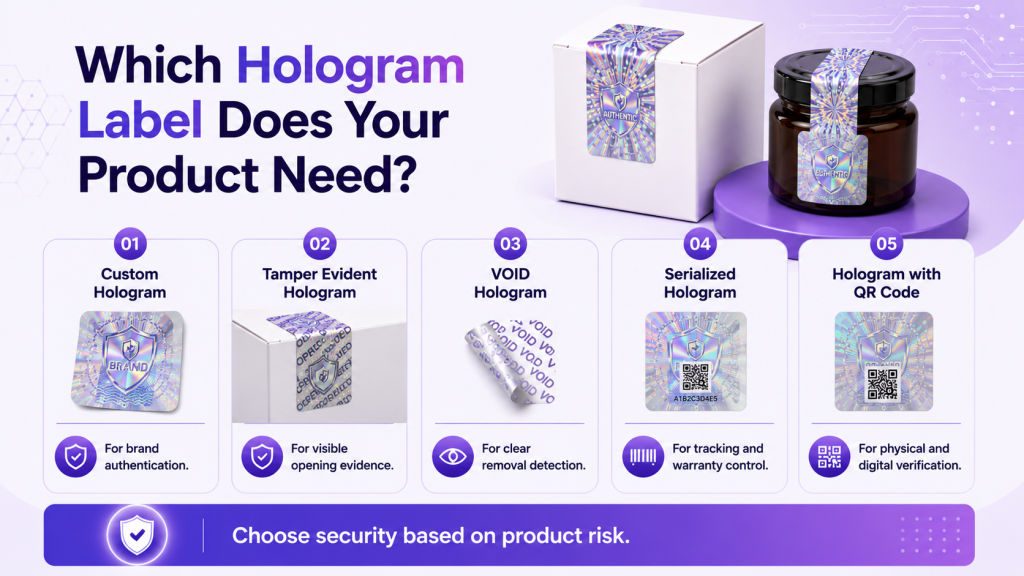
The right hologram label depends on your product risk, packaging surface, industry, and distribution channel.
A standard hologram label works well when the goal is visual authentication and brand trust. A tamper-evident hologram label is better when the product must show signs of opening or label removal. A VOID hologram label leaves behind a visible pattern after removal, which makes tampering easier to detect. A serialized hologram label adds a unique code to each product, helping with tracking, warranty verification, or batch-level control.
Some brands also combine hologram labels with QR codes. This gives both physical and digital authentication. The hologram protects the label visually, while the QR code can connect the customer or distributor to product information, verification pages, warranty details, or traceability records.
Global barcode standards are also moving toward richer 2D codes that can connect product identifiers with online product information, which makes the combination of holograms and QR codes increasingly relevant for packaging.
Advantages of Hologram Labels
The biggest advantage of hologram labels is instant visibility. A distributor, retailer, or customer does not need special equipment to notice the label. The visual effect itself acts as the first level of authentication.
They also improve brand perception. A custom hologram gives the product a premium and protected appearance, especially in crowded categories where duplicate packaging is common.
For industries like pharma, cosmetics, automotive, liquor, electronics, FMCG, and agro products, hologram labels can support trust across the supply chain. They help buyers identify genuine products and help brands reduce the risk of duplication, refilling, and unauthorized resale.
Limitations You Should Know
Hologram labels are powerful, but they are not a complete security system by themselves.
A low-quality hologram can still be imitated. A generic stock hologram may not protect a brand strongly because counterfeiters can use similar-looking materials. A hologram without serialization cannot track individual products. And a label without tamper-evident adhesive may not reveal if someone carefully removes it.
That is why brands should avoid treating holograms as only a shiny sticker. The right design should consider product risk, supply chain movement, customer verification, and tamper evidence.
When Should Your Product Use a Hologram Label?
You should consider hologram labels if your product faces any of these risks:
- Counterfeit copies in the market
- Refilling or repackaging risk
- Warranty fraud
- Distributor-level leakage
- Duplicate packaging
- Premium product positioning
- Regulatory or inspection requirements
For example, a cosmetic brand may use a hologram label to show authenticity. A lubricant manufacturer may use a tamper-evident hologram seal to prevent refilling. A pharmaceutical company may use serialized hologram labels for batch-level traceability. An electronics brand may use hologram warranty labels to reduce fake claims.
The decision is not only about security. It is also about how easily your customer can trust the product before buying it.
Why Work with Jainytic for Hologram Labels?
Choosing the right label partner matters because security labels require more than printing. They require the right material, adhesive, finishing, application understanding, and product-specific customization.
Jainytic helps brands create custom security labels, hologram labels, tamper-evident labels, QR-based labels, self-adhesive labels, and packaging label solutions for multiple industries.
For businesses searching for custom hologram label manufacturers in Delhi NCR, Jainytic offers practical support from label design to production, helping brands choose the right security layer based on the product type, packaging surface, and risk level.
Whether you need simple holographic stickers, tamper-evident seals, serialized labels, or a combination of hologram and QR security, Jainytic can help you build packaging that looks professional and protects brand trust.
Final Thoughts
Hologram labels work because they solve a simple but important problem.
They make authenticity visible.
In a market where duplicate products can damage customer trust, brand reputation, and revenue, a hologram label adds an immediate layer of protection. It helps customers identify genuine products, gives distributors a visible security marker, and makes packaging harder to copy.
But the best results come when hologram labels are designed with purpose. A high-risk product may need tamper evidence. A premium product may need a custom brand hologram. A regulated product may need serialization. A consumer-facing product may benefit from QR-based verification.
That is why working with experienced hologram label manufacturers is important. The right label is not just about shine. It is about security, trust, and product protection.
If your brand is looking for custom hologram label manufacturers in Delhi NCR, Jainytic can help you choose and create the right label solution for your product.
Frequently Asked Questions
Hologram labels are security labels that use reflective optical effects to create a changing visual appearance when viewed from different angles. They are commonly used for product authentication, anti-counterfeit packaging, warranty labels, tamper seals, and brand protection.
Hologram labels work by reflecting light through micro-patterns and optical structures on the label surface. These patterns create depth, movement, colour shift, or hidden effects that are difficult to reproduce using normal printing methods.
Some hologram labels are tamper-evident, but not all of them are. A tamper-evident hologram may break apart, leave a VOID mark, or show visible damage when removed. Brands should choose the adhesive and security layer based on the level of protection needed.
Hologram labels are used in pharmaceuticals, cosmetics, liquor, FMCG, automotive parts, electronics, agrochemicals, documents, certificates, and warranty-based products. Any brand facing counterfeiting or product duplication risk can benefit from them.
Start by identifying your risk. If your product is copied, use a custom hologram. If it can be opened or refilled, use a tamper-evident hologram. If you need tracking, add serialization or QR verification. A professional label partner can help you select the right structure.