The Label That Protects More Than Packaging
Imagine a customer holding two identical products in a store.
Same bottle. Same logo. Same price.
One is original. One is fake.
Now the customer asks one simple question:
“How do I know which one to trust?”
That is where the right security label makes the difference.
For manufacturers, packaging is no longer only about presentation. It is about protection, authentication, traceability, and trust. That is why many brands now work with experienced security label manufacturers before launching or scaling a product.
The Real Problem: Not Every Security Label Solves the Same Risk
Most businesses make one common mistake.
They choose a security label because it looks premium, not because it solves the right risk.
A hologram label can make a product look authentic. A VOID label can show if someone has tried to remove or open the seal. A serialized QR code can help trace the product digitally. But each one protects the product in a different way.
So, the real question is not:
“Which label looks better?”
The real question is:
“What exactly do you need to protect?”
Before selecting a label, identify whether your biggest risk is counterfeiting, tampering, warranty fraud, supply chain leakage, or consumer trust.
What a Security Label Actually Does
A security label is designed to make a product harder to copy, easier to verify, or impossible to tamper with silently.
In simple terms, it answers three important questions:
Is this product genuine?
Has this product been opened or altered?
Can this product be traced back to a batch, dealer, region, or customer interaction?
Modern security labels can use holography, tamper evident adhesives, destructible films, barcodes, QR codes, serial numbers, and authentication systems. The best solution depends on your product category, surface, threat level, and budget.
Option 1: Hologram Labels
Hologram labels are one of the most recognized anti counterfeiting solutions in packaging. They use optical effects, brand marks, and reflective elements that are difficult to reproduce with regular printing.
They are useful when a product needs instant visual trust. Customers, retailers, and distributors can quickly identify a branded security mark.
Advantages:
They improve shelf trust and brand perception. They are harder to copy when custom-designed and work well for cosmetics, electronics, liquor, pharma, FMCG, and automotive spare parts.
Limitations:
A basic hologram can still be copied. It may not confirm product-level traceability unless combined with serialization, and it does not prove tampering unless made with destructible or tamper evident material.
Best for:
Brands that need visible anti-counterfeit protection and premium authentication on the product surface.
Option 2: VOID and Tamper Evident Labels
VOID labels are designed to reveal tampering. When someone peels the label, a hidden message appears on the surface, the label, or both. This makes reapplication difficult without visible evidence.
These labels are useful when the main risk is product opening, seal breaking, warranty misuse, repacking, or unauthorized access.
Advantages:
They give clear visual proof of tampering and work well for electronics, pharma packs, cartons, warranty seals, logistics packaging, documents, and high-value products.
Limitations:
They do not always prove whether the product is original. They also need the right adhesive, film, and surface testing because performance changes across glass, HDPE, metal, paperboard, and textured plastic.
Best for:
Businesses that need tamper visibility more than decorative authentication.
Option 3: Serialized QR Code Labels
Serialized QR code labels give every product a unique digital identity. When scanned, the code can verify authenticity, show product details, capture warranty registration, or track supply chain movement.
They are especially powerful for brands that want both security and data.
Advantages:
They enable product-level traceability, scan-based authentication, batch tracking, warranty validation, recall support, and customer engagement. They can also detect duplicate or suspicious scan activity.
Limitations:
A QR code is only as strong as the system behind it. Businesses need serialization, backend validation, duplicate scan alerts, and strong print quality.
Best for:
Brands that need traceability, digital verification, customer engagement, or warranty control.
Security Label Comparison
| Security Label Type | Best Use | Strength | Limitation |
| Hologram Label | Visual authenticity and anti-counterfeit branding | Easy for customers and retailers to recognize | Generic holograms can be copied if not customized |
| VOID Label | Tamper evidence and warranty protection | Shows clear evidence after removal | Does not provide digital traceability by itself |
| Serialized QR Code | Digital verification and supply chain tracking | Gives every product a unique identity | Needs backend validation and scan monitoring |
| Layered Security Label | High-risk products needing multiple protections | Combines authenticity, tamper evidence, and tracking | Requires better planning and expert production |
How to Decide Which Label Your Business Needs
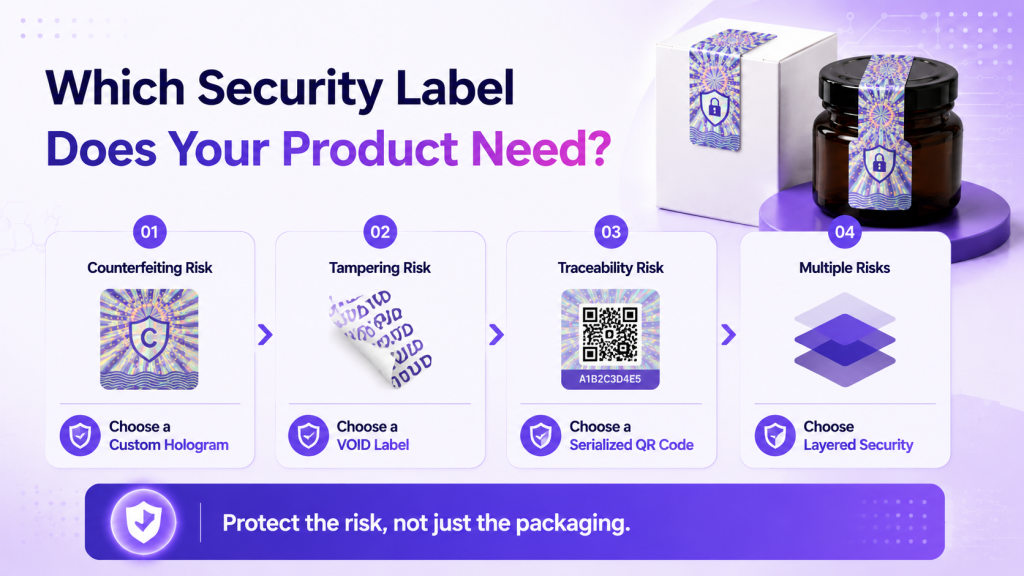
Choose a hologram label if your biggest risk is product duplication or lookalike packaging.
Choose a VOID label if your biggest risk is tampering, seal breaking, refilling, repacking, or warranty misuse.
Choose a serialized QR code if your biggest risk is traceability, fake distribution, grey market movement, warranty fraud, or poor visibility after dispatch.
Choose a layered security label if your product is high risk. Pharma, liquor, electronics, cosmetics, or automotive products may need a hologram, a VOID layer, and a serialized QR code together.
This is where professional security label manufacturers add real value. They do not just print labels. They help you match the label structure to the actual risk.
Important Factors Before Finalizing a Security Label
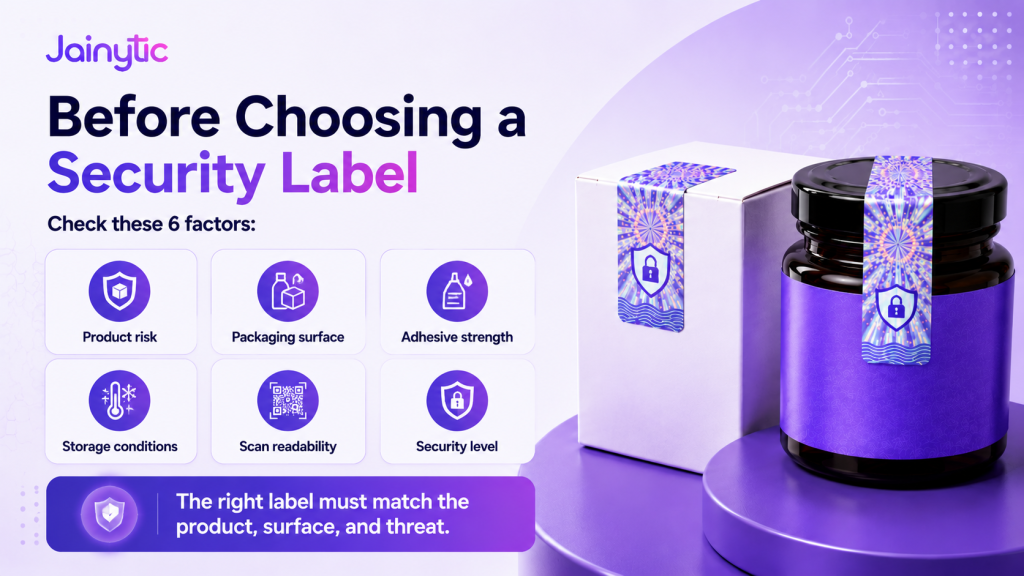
The right label depends on more than design.
Consider packaging material, adhesive strength, application method, temperature, moisture, handling, label size, print durability, scan readability, and shelf life.
A security label for a glass bottle is different from one used on an HDPE container, a corrugated carton, a shrink sleeve, a metal part, or a flexible pouch. That is why businesses searching for security label manufacturers in Delhi NCR should evaluate technical capability, not just printing capacity.
Ask whether the manufacturer can support custom holography, tamper evident materials, variable data printing, QR serialization, roll supply, batch consistency, and label testing.
Industry-Wise Label Selection
For pharma and healthcare products, tamper evidence and traceability matter most. VOID labels and serialized QR codes work well, often with hologram layers for authenticity.
For cosmetics and personal care, visual trust is important. Hologram labels help protect premium branding, while QR codes can support customer education and verification.
For automotive and industrial products, counterfeiting and warranty fraud are major risks. Serialized labels, destructible films, and tamper evident seals are useful.
For food, beverage, and liquor brands, hologram labels, neck seals, shrink sleeves, and QR authentication can help protect brand identity and consumer confidence.
For electronics, VOID labels are especially useful for warranty seals, device packaging, and after-sales protection.
Why Jainytic Helps Brands Choose Better
Jainytic works with businesses that need packaging and label solutions designed for real-world product protection. When brands search for reliable security label manufacturers, the goal should not be to buy the most complex label. It should be to buy the right security layer for the right product risk.
Jainytic supports brands with security labels, hologram labels, tamper evident solutions, self adhesive labels, shrink sleeve labels, wet glue labels, tag labels, HDPE containers, and other packaging solutions for different industries.
For brands looking for security label manufacturers in Delhi NCR, Jainytic brings the advantage of local manufacturing understanding, customization, application support, and practical packaging experience.
Final Thoughts: Security Starts with the Right Question
A security label is not just a sticker.
It is a trust signal. It is a protection layer. It is often the first thing that tells a customer, retailer, or distributor that the product is genuine and untouched.
But the right label depends on the right question.
Do you need to stop counterfeiting?
Do you need to show tampering?
Do you need to trace every product digitally?
Or do you need all three?
Once that is clear, the choice becomes easier. Work with experienced security label manufacturers who understand materials, printing, adhesives, serialization, and industry use cases. The right security label will not only protect your product, it will protect your brand reputation.
Frequently Asked Questions
The best security label depends on your product risk. Hologram labels support visual authentication, VOID labels show tampering, and serialized QR codes support tracking and verification. High-risk products often need a combination of these options.
Hologram labels help reduce counterfeiting by adding a visual authentication layer, but they are strongest when customized and combined with other features. Generic holograms are easier to imitate, so serious brands should use custom designs or serialized QR codes for stronger protection.
A regular sticker can often be removed and reapplied without clear evidence. A VOID label is designed to reveal a hidden message or visible damage when someone tries to remove it. This makes it useful for warranty seals, pharma packs, electronics, logistics, and products that require tamper evidence.
Working with security label manufacturers in Delhi NCR gives businesses easier access to customization, faster communication, local production support, and practical packaging guidance. It is especially useful for brands operating across Delhi NCR and nearby industrial regions.
Yes. Many brands use multi-layer security labels that combine visual authentication, tamper evidence, and digital verification. This approach is useful for high-value products, regulated industries, warranty-sensitive products, and brands facing frequent counterfeiting.