

A smaller medicine pack does not reduce the amount of information a brand needs to communicate. It only reduces the space available to communicate it clearly.
The Pack Gets Smaller, but the Information Does Not
A customer picks up a small bottle of oral drops, a topical tube, or a compact healthcare container.
The pack may need to show the product name, strength, dosage form, active ingredients, directions, warnings, storage instructions, batch information, expiry details, manufacturer information, and variable data.
When all of this is forced onto one small surface, text becomes difficult to read and important details begin competing for attention.
This is where multilayer labels for pharmaceutical packaging become useful. They create additional printable space without requiring a larger bottle, tube, or container.
The Real Question Is Not How Small the Text Can Be
Many small pack designs begin with the wrong question: how much information can be compressed, abbreviated, or printed in a smaller font?
That approach may save space, but it can weaken readability. A patient, pharmacist, distributor, or healthcare professional should not have to search through an overloaded panel to find an instruction.
The better question is simple:
How can the information be organized so that primary details remain visible and supporting details remain accessible?
Multilayer labels for pharmaceutical packaging solve this problem by separating content into logical panels instead of placing everything on one surface.
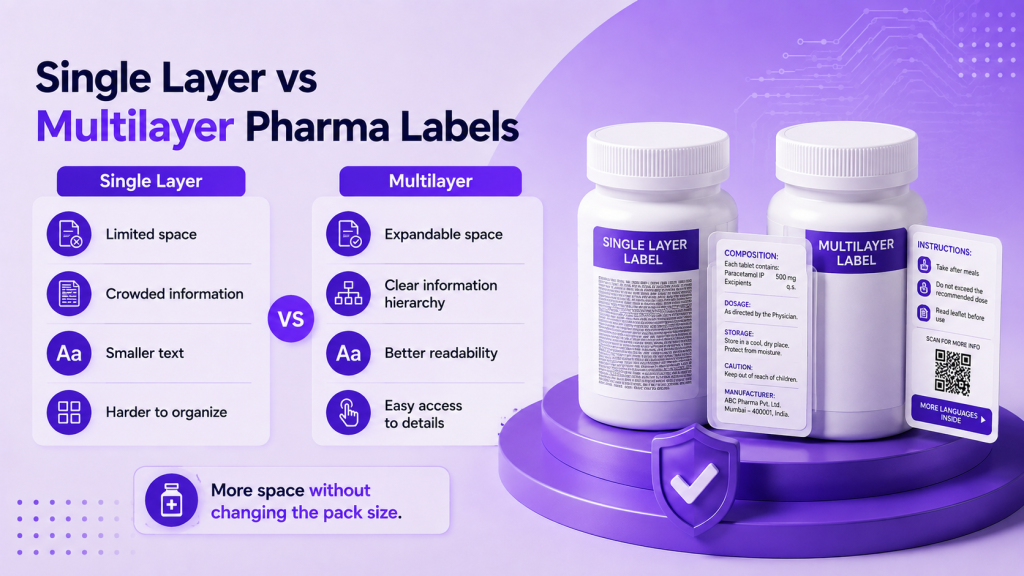
What Are Multilayer Labels?
Multilayer labels contain two or more printable layers. The upper panel can be lifted to reveal additional information underneath, and some constructions can be closed again after reading.
They may also be called peel and read labels, booklet labels, expanded content labels, or two ply labels.
Multilayer labels for pharmaceutical packaging can keep product identification on the outer panel while placing detailed directions, warnings, ingredients, or multilingual content on the inner panels.
A standard label uses the visible surface once. A multilayer label turns the same container area into organized, expandable communication space.
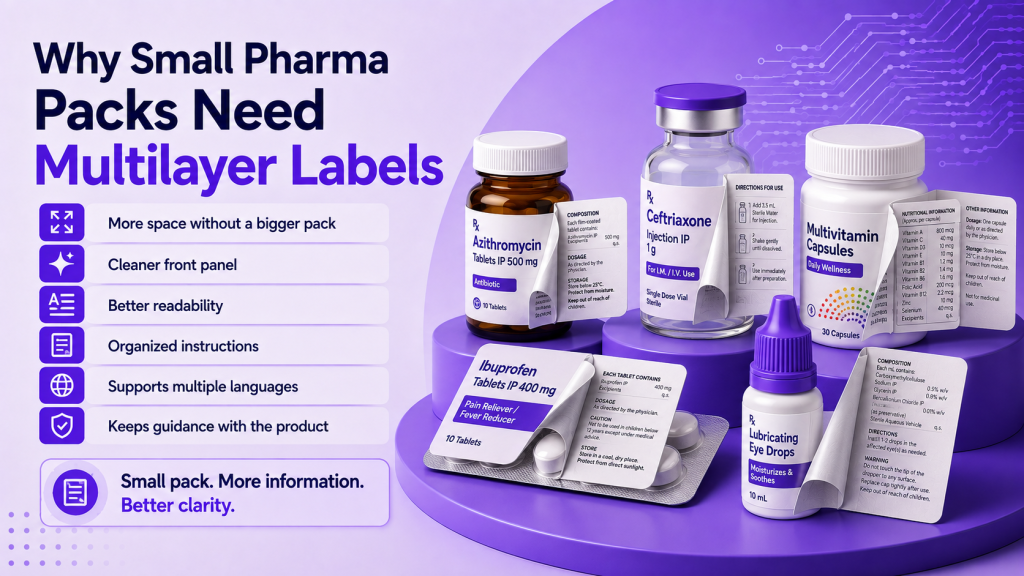
1. They Add Space Without Increasing the Pack
The most direct advantage is additional printable area. A larger container may affect filling, transportation, secondary packaging, shelf space, and the user experience.
A multilayer construction allows the brand to retain a compact pack while creating room for directions, precautions, composition, storage details, and other approved information.
2. They Keep the Main Panel Clear
The visible panel should help users identify the product quickly. The product name, strength, dosage form, quantity, and other priority details should not compete with long paragraphs.
Multilayer labels for pharmaceutical packaging allow detailed content to move inside while the outer panel remains focused and easier to scan.
3. They Organize Instructions More Clearly
More space helps only when it is structured well. Inner panels can separate directions, warnings, storage, ingredients, handling, and manufacturer details.
Clear headings, spacing, and panel order make information easier to locate than one dense block of very small text.
4. They Support Multiple Languages
Some products are distributed across regions where approved information must appear in more than one language.
A multilayer format can separate languages by panel, reducing visual competition on the outer face. The final language, claims, and arrangement must still follow the approved artwork and applicable market requirements.
5. They Keep Guidance Attached to the Product
Leaflets and cartons may carry detailed information, but they can become separated from the immediate container after purchase.
A securely applied multilayer label keeps supporting guidance with the product during use. This can help when a user needs to review directions, precautions, or storage information again.
Multilayer labels for pharmaceutical packaging do not automatically replace a package insert or carton. Their role depends on the approved packaging system.
6. They Protect Readability
Reducing font size is often treated as the easiest answer to limited space. However, very small text, tight line spacing, low contrast, and narrow margins can make information difficult to read.
Expanding the printable area allows better spacing and hierarchy. The goal is not to fill every inner panel, but to give important content enough room to remain clear.
Single Layer Pharma Labels vs Multilayer Pharma Labels
| Label Factor | Single Layer Label | Multilayer Label |
| Printable area | Limited outer surface | Additional internal panels |
| Front panel | May become crowded | Can remain focused |
| Detailed content | Compressed into small space | Organized across sections |
| Multiple languages | Compete on one panel | Can be separated by panel |
| User access | All content visible together | Extra content opens when needed |
| Construction | Simpler format | Needs opening and application testing |
When Does a Small Pharma Pack Need a Multilayer Label?
A multilayer label may be worth considering when the container has limited printable area, approved copy cannot remain readable on one panel, or the product requires detailed directions and warnings near the point of use.
It may also help when several languages are needed or when the visible design must remain easy to identify.
The decision should consider the container shape, label area, cap or dispensing function, opening method, application equipment, storage environment, and whether the user can open and reclose the label comfortably.
What Must Be Planned Before Selecting the Label?
Start with the approved content and actual container. The label must fit without interfering with caps, droppers, seams, measurement marks, or dispensing areas. Its opening tab should be easy to find but secure during packing and transit.
Materials and adhesives must suit moisture, refrigeration, friction, chemicals, temperature changes, and curved surfaces. These conditions affect adhesion, print protection, opening, and reclosure.
Batch and expiry coding need a clear location. Multilayer labels for pharmaceutical packaging should then be tested on the actual pack and intended labeling line because a flat sample may behave differently on a curved bottle or flexible tube.
Where Multilayer Labels Are Commonly Useful
Multilayer labels can support small oral liquid bottles, topical products, veterinary packs, nutraceuticals, and diagnostic products that need directions, warnings, storage guidance, several languages, or detailed handling information. The construction must always match the product and its approval requirements.
A Multilayer Label Is Not a Shortcut Around Compliance
More space does not allow a brand to add unapproved claims, remove required information from another packaging level, or reorganize critical details without review.
Indian drug rules require important particulars to appear conspicuously on the immediate pack and other coverings. International guidance also emphasizes identification, batch, expiry, storage, directions, warnings, and manufacturer information.
Regulatory, quality, medical, artwork, and packaging teams should approve the content and panel sequence before production. Multilayer labels for pharmaceutical packaging solve a space and usability challenge. They do not replace regulatory assessment.
How Jainytic Helps Brands Develop Multilayer Pharma Labels
At Jainytic, multilayer labels are planned around pack size, surface, content volume, opening behavior, storage conditions, application method, and production requirements.
As a label manufacturer in Delhi NCR, Jainytic supports brands with two ply, peel and read, expanded content, self adhesive, and security labels.
Jainytic then recommends suitable materials, adhesives, release systems, panel structures, print protection, and application testing. The aim is to create multilayer labels for pharmaceutical packaging that provide more information space without making the pack difficult to use or manufacture.
Final Thoughts: Small Packs Need Better Information Design
The challenge with a small pharma pack is not simply limited space. It is the need to keep important information visible, readable, organized, and attached to the product.
A crowded single layer label can make users work harder to understand the pack. A well planned multilayer label separates primary identification from supporting guidance and gives each type of information a suitable place.
When the pack is small but the communication requirement is large, multilayer labels for pharmaceutical packaging can balance compact design, readability, and controlled information delivery.
Frequently Asked Questions
They contain two or more printable layers. The upper panel opens to reveal additional information, and some versions can be closed again.
Multilayer labels for pharmaceutical packaging create more printable space without increasing the container size and help organize approved directions, warnings, ingredients, and storage details.
Not automatically. The answer depends on the product approval, packaging system, market, and applicable requirements. Regulatory review is essential.
Yes, but dimensions, adhesive, construction, and opening direction must be tested on the actual surface.
Yes, when materials, adhesive, inks, coatings, and construction are tested for the intended temperature and condensation.
Jainytic helps brands plan dimensions, panel structure, materials, adhesives, opening tabs, print protection, variable data areas, and application testing according to the product and pack.