
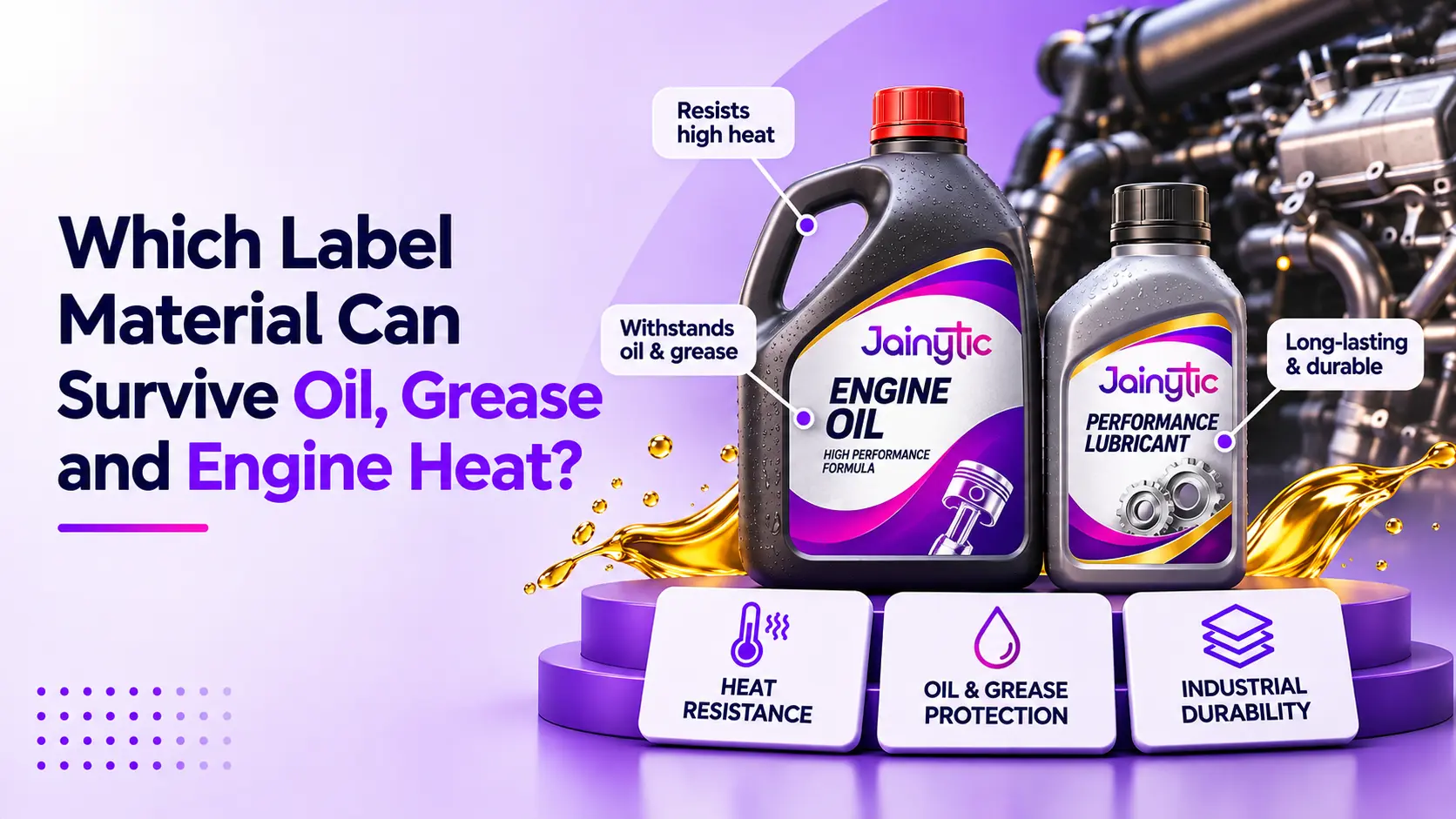
If the Label Gives Up Before the Engine Does, It Was the Wrong Label.
Automotive and lubricant labels live in environments where ordinary packaging labels can fail quickly.
A label may look perfect when it is first applied to an oil bottle, grease cartridge, coolant container, spare part, filter, battery component, or under-hood surface. Then it meets the real environment: engine oil, grease, fuel splash, chemicals, abrasion, heat, vibration, and repeated handling.
That is when weak face materials swell, inks smear, adhesives soften, edges lift, and important information becomes unreadable.
For these applications, the question is not simply whether a label is waterproof or permanent. The label has to be engineered as a complete system: face material, adhesive, ink, laminate or coating, container surface, application temperature, and service temperature all matter.
For many demanding automotive applications, polyester film is one of the strongest starting points. Polypropylene can also perform well on lubricant and oil packaging where extreme heat is not the primary challenge. The correct choice depends on how much heat, oil, chemical exposure, flexing, and abrasion the label will actually face.
Why Oil, Grease and Engine Heat Are So Hard on Labels
Automotive environments attack labels in several ways at once.
Oil and grease can migrate across the label surface and edges. Heat can soften adhesives or distort some films. Chemicals can attack inks and coatings. Dirt and workshop handling increase abrasion. Flexible plastic containers can squeeze and expand. Metal or engine components can become much hotter than ordinary packaging.
A label that survives only one of these conditions may still fail in the field.
1. Oil and Grease Can Attack More Than the Printed Surface
Lubricants and greases do not only sit on top of a label. They can reach exposed edges and interact with adhesives, coatings, inks, and face materials.
If the adhesive is not resistant to oily environments, the bond may weaken gradually. Edge lifting can then allow even more contamination underneath the label.
For oil bottles, grease packs, and automotive components, resistance should be tested with the actual fluid wherever possible.
2. Heat Changes Adhesive and Film Behaviour
Heat can reduce adhesive holding power, accelerate chemical interaction, and cause some label materials to soften, stretch, shrink, or distort.
The critical temperature depends on the application. A lubricant bottle stored in a warehouse faces a different thermal load from a label placed near an engine, radiator, battery, or hot metal component.
This is why service temperature must be specified clearly before choosing a label.
3. Abrasion Can Destroy a Label That Still Remains Attached
Even when adhesion remains strong, printed information can fail through rubbing, scraping, workshop handling, transport, or contact with oily gloves.
If batch codes, safety warnings, QR codes, or instructions become unreadable, the label has still failed.
Print protection is therefore just as important as adhesive strength.
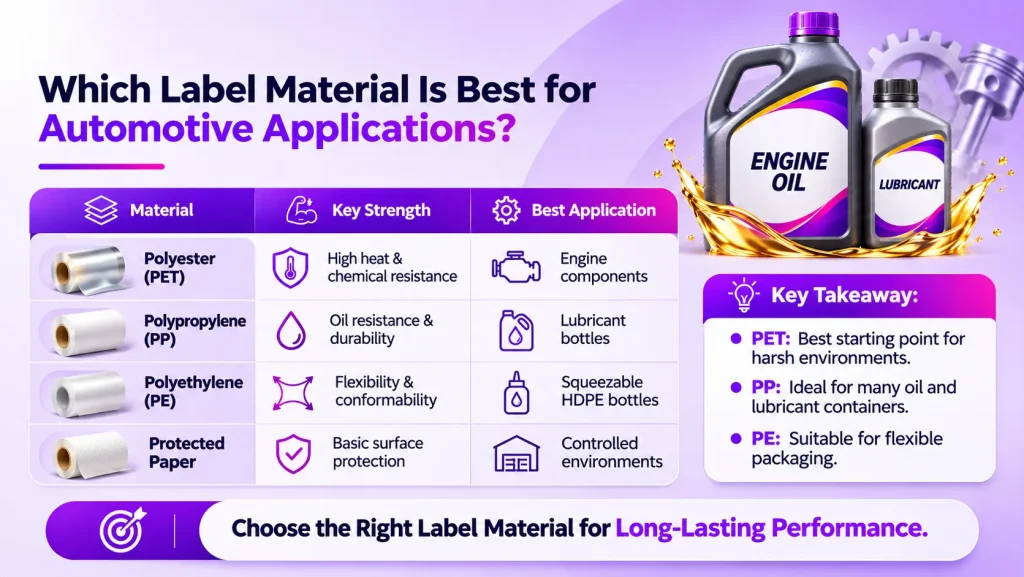
Which Label Materials Perform Best?
1. Polyester (PET): The Strongest Choice for Harsh Automotive Conditions
Polyester film is often selected for demanding industrial and automotive labels because it offers strong dimensional stability, tear resistance, chemical resistance, and heat tolerance.
It is especially useful when the label must remain legible and physically stable around machinery, automotive parts, batteries, filters, under-hood components, or containers exposed to aggressive fluids.
PET can also support durable print systems and protective laminates.
- Higher heat environments
- Oil and chemical exposure
- Abrasion-prone applications
- Long service life
- Barcode and serial-number durability
- Automotive components and industrial identification
2. Polypropylene (PP): A Strong Option for Lubricant and Oil Packaging
Polypropylene film is widely used in packaging because it combines moisture resistance, printability, durability, and cost efficiency.
For engine oil bottles, lubricant containers, coolant packs, and other plastic packaging, a PP self-adhesive label can be a strong choice when the expected heat level remains within the construction’s tested range.
PP is generally better suited to packaging applications than to the hottest under-hood identification environments.
3. Polyethylene (PE): Useful When the Container Flexes
PE film can be useful on squeezable or flexible plastic containers because the label can move with the pack more effectively than a rigid construction.
This can help reduce wrinkling or edge stress on flexible lubricant, chemical, or automotive-care bottles.
Its suitability for heat and chemical exposure must still be checked against the exact application.
4. Paper: Usually the Higher-Risk Option
Paper labels can work on automotive products kept in relatively controlled environments, especially when protected with suitable coatings or laminates.
However, unprotected paper is generally more vulnerable to oil staining, grease penetration, tearing, moisture, and abrasion.
For workshop, lubricant, chemical, or engine-adjacent use, a durable film construction is often a safer starting point.
Quick Comparison of Label Materials
| Material | Oil/Grease Resistance | Heat Resistance | Flexibility | Typical Use |
| Polyester (PET) | High | High when correctly specified | Moderate | Automotive parts, industrial identification, harsh environments |
| Polypropylene (PP) | Good to high | Moderate depending on grade | Good | Lubricant bottles, oil containers, automotive packaging |
| Polyethylene (PE) | Good | Moderate depending on grade | High | Flexible and squeezable plastic containers |
| Protected paper | Moderate with suitable barrier | Application dependent | Low | Controlled packaging environments |
The Face Material Is Only Half the Decision
A PET label can still fail if the adhesive is wrong.
For automotive and lubricant applications, the adhesive must be selected for the substrate and the environment. A label on an HDPE oil bottle has a different adhesion challenge from a label on painted metal, glass, powder-coated steel, or an engine component.
The adhesive specification should consider:
- Surface type: HDPE, PP, PET, metal, glass, painted surfaces, textured plastics, and powder-coated components behave differently.
- Surface energy: Low-surface-energy plastics such as HDPE and PP often need specially formulated adhesives.
- Oil resistance: The adhesive should maintain bond strength if lubricant or grease reaches the label edge.
- Application temperature: Some adhesives need a minimum surface temperature to wet out correctly.
- Service temperature: The label must remain secure at the highest and lowest temperatures it will actually experience.
- Surface contamination: Oil, dust, silicone, mould-release residue, or cleaning chemicals can prevent proper bonding.
What Does ‘Heat Resistant’ Actually Mean?
The phrase ‘heat resistant label’ is too vague to be useful on its own.
A label may survive 60°C storage but fail near a component that repeatedly reaches much higher temperatures. Another label may tolerate a short heat spike but not continuous exposure.
Packaging teams should distinguish between application temperature, continuous service temperature, and short-duration peak temperature.
The complete construction should be rated, not just the face film.
Where Different Label Constructions Make Sense
Engine oil and lubricant bottles
PP or PE film labels with oil-resistant adhesive and suitable print protection are often practical. HDPE bottle surfaces may require low-surface-energy adhesive chemistry.
Grease cartridges and workshop products
Durable film constructions are preferable where grease, dirty handling, and abrasion are expected.
Coolant, brake fluid, and automotive chemical containers
Chemical resistance should be tested against the actual formulation. PET or durable PP constructions may be appropriate depending on temperature and exposure.
Under-hood components
Polyester is often the stronger starting point because the label may need better heat, chemical, and dimensional stability.
Batteries and electrical components
Durable film labels with strong chemical and abrasion resistance are commonly required, especially where safety or identification information must remain legible.
Spare parts and industrial identification
PET labels with durable print and adhesive systems are often suited to long-life tracking, serialisation, QR codes, and barcodes.
Why Lamination and Print Protection Matter
Automotive labels can fail visually long before they detach.
Oil, grease, cleaning chemicals, and repeated rubbing can attack inks and coatings. A protective laminate or resistant over-varnish can reduce scuffing and chemical damage.
For labels carrying safety instructions, traceability data, barcodes, or compliance information, print durability should be treated as a functional requirement, not only a cosmetic one.
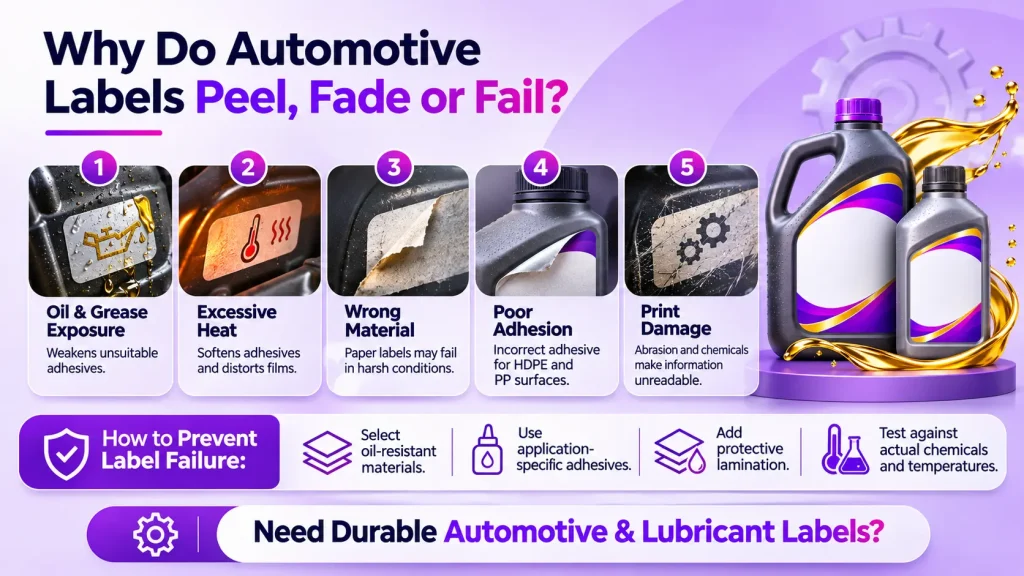
Common Reasons Automotive Labels Fail
- Using a general-purpose paper label in an oily environment.
- Selecting a heat-resistant face film but ignoring adhesive temperature limits.
- Applying labels to oily, dusty, or contaminated surfaces.
- Using the same adhesive for metal and low-surface-energy plastic.
- Skipping exposure testing with the actual lubricant or chemical.
- Placing label edges where oil can pool or where the container flexes.
- Using inks or varnishes that cannot tolerate workshop abrasion.
- Confusing short-term temperature resistance with continuous service temperature.
How to Test a Label for Oil, Grease and Heat
A datasheet is useful, but production testing is essential.
The final label should be tested on the actual container or component under conditions that reproduce real handling.
- Apply the label to the actual substrate using the intended production process.
- Allow the specified dwell time for the adhesive to build bond strength.
- Expose the label to the actual oil, grease, coolant, cleaner, or chemical expected in service.
- Test repeated wiping and handling with oily gloves.
- Run the label through the expected continuous service temperature.
- Test short-duration peak temperatures where relevant.
- Cycle the sample between hot and cold conditions if the application experiences thermal cycling.
- Check edge lift, bubbling, shrinkage, adhesive movement, print scuffing, staining, and barcode readability.
- Repeat testing after ageing where the label is expected to remain in service for months or years.
A Simple Selection Guide
| Application | Recommended Starting Point | Key Requirement |
| Oil bottle | PP or PE self-adhesive film | Oil resistance + LSE adhesive where needed |
| Grease pack | Durable PP/PET film | Grease resistance + abrasion resistance |
| Automotive chemical container | PP or PET film | Chemical resistance + print protection |
| Under-hood component | Polyester label | Higher heat + chemical stability |
| Flexible HDPE bottle | Flexible film + LSE adhesive | Conformability + strong bond |
| Long-life serial/barcode label | PET + durable print/laminate | Legibility + dimensional stability |
How Jainytic Helps with Automotive and Lubricant Labels
At Jainytic Packaging, automotive and lubricant labels are selected around the complete use environment rather than only the printed artwork.
Jainytic supports self-adhesive labels, security labels, multilayer labels, and packaging solutions for automotive, chemical, lubricant, and industrial applications.
The specification can consider container material, surface energy, product chemistry, oil and grease exposure, heat range, abrasion, label flexing, application method, and required service life.
This application-first approach helps ensure that the label remains attached and readable from filling and distribution through workshop handling and end use.
Final Thoughts: The Toughest Label Is the One Designed for the Actual Environment
There is no single label material that is automatically best for every oil, grease, or heat-exposed application.
For severe automotive and industrial environments, polyester is often the strongest starting point because of its dimensional stability, durability, and resistance profile. For lubricant and oil packaging, polypropylene and polyethylene films can provide an effective balance of durability, flexibility, and cost.
But material alone does not decide performance.
The adhesive, print system, laminate, application temperature, service temperature, substrate, and actual chemical exposure all have to work together.
If the label has to survive where the product works, it must be specified for that environment from the beginning.
Frequently Asked Questions
Polyester and polypropylene films are common starting points because they offer better resistance to moisture, oils, and handling than unprotected paper. The final choice depends on heat, chemical exposure, flexibility, and adhesive requirements.
Polyester is often preferred for higher-temperature automotive and industrial applications because it provides strong dimensional stability and durability. The complete label construction must still be rated for the actual continuous and peak temperatures.
They can be used in controlled applications with appropriate coatings or laminates, but film labels are generally a safer choice where oil, grease, moisture, and abrasion are expected.
Common causes include oil reaching the adhesive interface, low-surface-energy bottle plastics, surface contamination, incorrect adhesive selection, container flexing, and application outside the recommended temperature range.
Yes. PP labels are widely suitable for many lubricant and automotive packaging applications when the adhesive, print protection, and service conditions are correctly matched.
PET is a stronger choice when the application requires greater dimensional stability, higher heat resistance, longer service life, or harsher chemical and abrasion performance.