
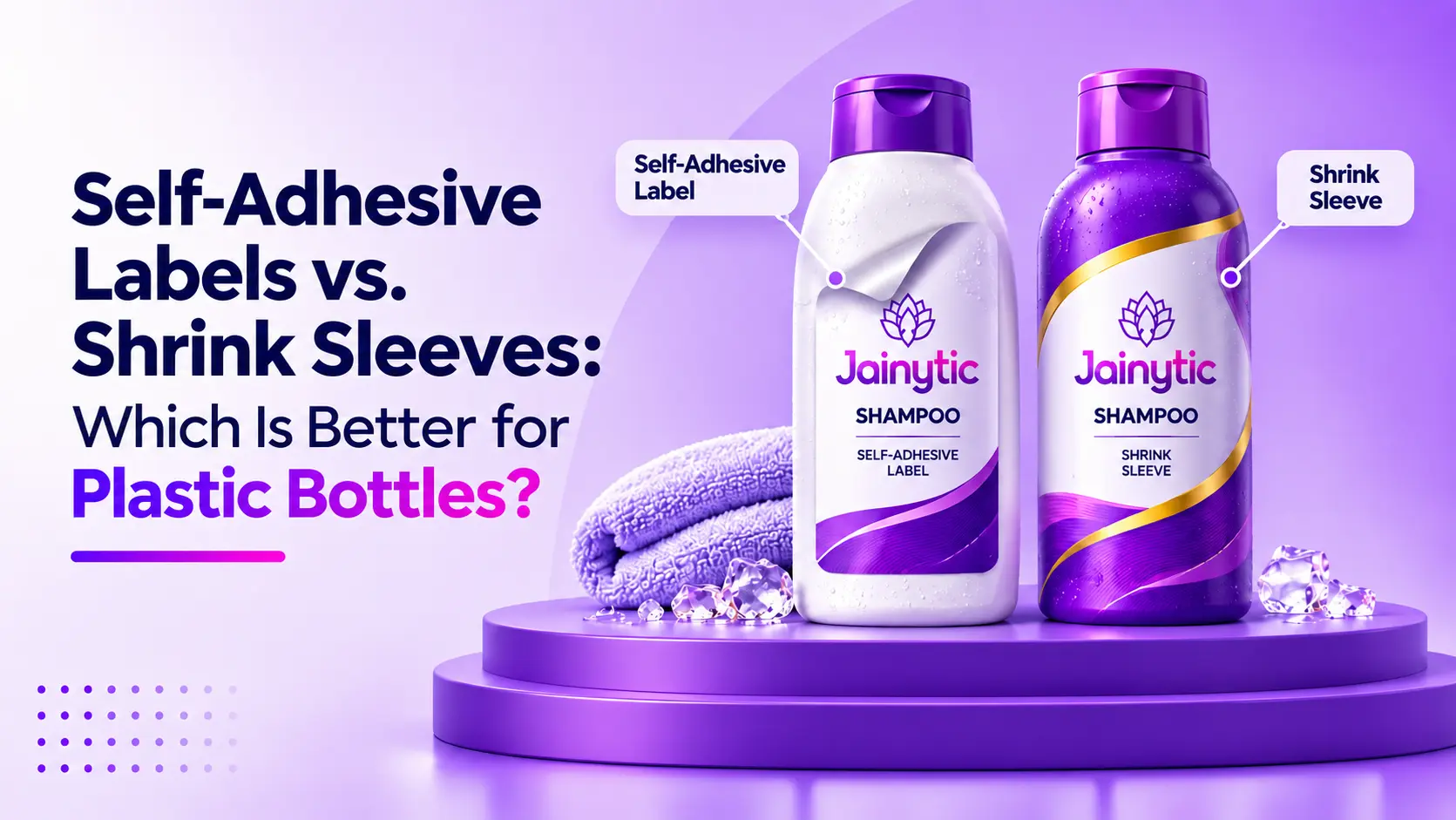
Your Bottle Has About Three Seconds to Win Attention. The Label Decides What Happens Next.
Two plastic bottles can contain equally good products and still perform very differently on the shelf. The difference is often not the bottle itself. It is how the bottle is decorated.
One brand uses a clean, precisely placed self-adhesive label. Another wraps the entire bottle in a high-impact shrink sleeve. Both can look premium. Both can survive demanding environments. Both can run efficiently on the right production line.
But they solve different packaging problems.
So the real question is not simply, “Which label looks better?” It is: Which labeling system fits your bottle shape, branding requirement, production volume, application process, durability needs, and budget?
For standard bottle shapes, multiple SKUs and flexible production, self-adhesive labels are often the more practical choice. For 360-degree graphics, highly contoured bottles and maximum shelf impact, shrink sleeves can be the stronger option.
This guide compares both formats so you can decide which one is better for your plastic bottle.
First, What Is the Difference Between Self-Adhesive Labels and Shrink Sleeves?
Self-Adhesive Labels
Self-adhesive labels, also called pressure-sensitive labels, are pre-coated with adhesive and applied directly to the bottle surface.
They can be produced in paper, PP, PE, PET, metallised and other constructions, depending on the appearance and performance required.
They are commonly applied as front labels, back labels, wraparound labels or custom die-cut shapes. They do not require heat or water activation during application.
Shrink Sleeves
Shrink sleeves are printed film tubes or sleeves placed around a bottle and then exposed to controlled heat. The film shrinks and conforms closely to the container.
Because the sleeve can wrap around the complete bottle, it can provide near 360-degree graphic coverage and can follow shapes that would be difficult for a flat label.
Shrink sleeves can also be designed to extend over caps or closures to provide visible tamper evidence.
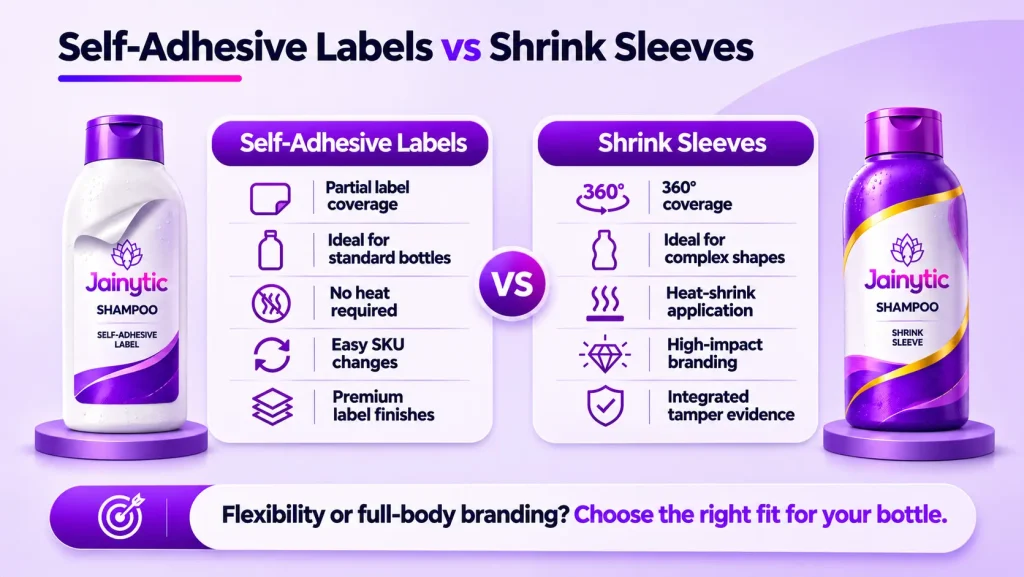
Quick Comparison: Self-Adhesive Labels vs Shrink Sleeves
| Decision Factor | Self-Adhesive Labels | Shrink Sleeves |
| Graphic coverage | Front, back or partial wrap | Near 360-degree/full-body |
| Bottle shape | Best on stable label panels and manageable curves | Strong for complex contours and unusual shapes |
| Application | Pressure-sensitive application; no heat needed | Sleeve placement plus controlled heat shrinking |
| SKU flexibility | Very good for frequent design or SKU changes | Good, but sleeve setup and shrink control are more involved |
| Tamper evidence | Requires separate feature or construction | Can integrate neck or cap tamper evidence |
| Material options | Paper and multiple film constructions | Primarily shrinkable films such as PETG and related materials |
| Variable data | Easy to incorporate through suitable printing/converting workflows | Possible, but usually less straightforward for late-stage changes |
| Shelf impact | Strong, especially with premium finishes | Very strong due to full-body coverage |
| Container visibility | Bottle remains visible outside label area | Can cover most or all of the bottle |
| Equipment needs | Label applicator or hand application | Sleeve applicator and heat tunnel or equivalent shrink process |
When Self-Adhesive Labels Are the Better Choice
1. When You Need Production Flexibility
Self-adhesive labels work well when a brand has multiple products, frequent artwork changes or short-to-medium production runs.
A manufacturer can change label rolls between SKUs without changing the bottle itself. Digital printing can support smaller batches and variable data, while flexographic printing can support larger volumes.
This makes self-adhesive labels particularly useful for brands that launch variants, seasonal packs, regional SKUs or promotional editions.
2. When the Bottle Has a Clear Label Panel
If the bottle has a smooth, flat or gently curved label area, a pressure-sensitive label can create a clean and controlled appearance without covering the complete pack.
This is common on PET beverage bottles, HDPE household product bottles, cosmetic bottles, lubricant packs and many pharmaceutical containers.
The container material still matters. HDPE and polypropylene are low-surface-energy plastics, so the adhesive should be selected specifically for those surfaces to prevent edge lifting.
3. When Premium Finishes Matter
Self-adhesive labels provide considerable finishing freedom. Depending on the material and print process, brands can use foil stamping, embossing, soft-touch effects, spot varnish, metallic films, clear films and textured stocks.
This is useful when the objective is not full-body coverage but a premium label area that feels intentionally designed.
4. When You Want Simpler Application
Pressure-sensitive labels can be applied manually or through high-speed automatic labeling systems.
Unlike shrink sleeves, the process does not require a heat tunnel to make the label conform to the container. That can simplify line setup for brands that already use conventional label applicators.
5. When You Need Easier Late-Stage Customisation
Batch information, barcodes, QR codes, serialisation and short-run design changes can be easier to manage with self-adhesive labels, especially when digital printing or variable-data workflows are used.
This is valuable in pharmaceutical, FMCG, logistics-linked and promotional applications.
When Shrink Sleeves Are the Better Choice
1. When the Bottle Shape Is Part of the Branding
A self-adhesive label is fundamentally a flat construction. It can work on curves, but compound curves, deep contours, narrow waists and unusual bottle profiles can create wrinkling or edge-lift risks.
A shrink sleeve is designed to conform around the container as heat is applied.
That makes it especially effective for bottles whose shape would otherwise restrict the printable label area.
2. When You Need 360-Degree Visual Impact
Shrink sleeves can turn almost the entire bottle into a printable branding surface.
Instead of dividing the pack into a front label and back label, the artwork can move around the full circumference and continue over shoulders or other shaped areas.
For beverages, personal care, household products and high-competition FMCG shelves, this additional visual real estate can be a major advantage.
3. When Tamper Evidence Needs to Be Integrated
A sleeve can extend across the bottle and closure, allowing the packaging to show visible evidence if the cap area has been opened.
This can reduce the need for a completely separate neck band or tamper-evident label, depending on the pack design and regulatory requirement.
4. When Moisture Exposure Is High
Shrink sleeves are film-based and can perform well in wet, refrigerated or condensation-prone environments when the material and print system are properly specified.
Because there are no pressure-sensitive label edges across the main decorated area, brands also avoid certain edge-lifting problems associated with poorly matched adhesive constructions.
5. When Shelf Differentiation Is the Main Objective
If the packaging brief is built around maximum visual disruption, colour coverage and unusual bottle geometry, shrink sleeves often have the advantage.
The format allows a brand to use the bottle itself as a complete graphic canvas rather than treating labeling as a smaller printed panel.
Which Option Is Better for Different Plastic Bottle Materials?
PET Bottles
Both self-adhesive labels and shrink sleeves are widely suitable for PET bottles. Self-adhesive labels work well when the bottle has a conventional label panel and the brand wants efficient, flexible application. Shrink sleeves are useful when the bottle needs complete graphic coverage, strong contour conformity or integrated tamper evidence.
HDPE Bottles
Self-adhesive labels can work very well on HDPE, but the adhesive must be formulated for low-surface-energy plastic. If the bottle is highly contoured or has a difficult label area, a shrink sleeve may provide more reliable visual coverage because it does not depend on pressure-sensitive adhesive across the main decorated surface.
PP Bottles and Containers
Polypropylene also has low surface energy, so pressure-sensitive label adhesion should be tested carefully. Shrink sleeves can be useful for complex PP container shapes, while self-adhesive labels remain practical where a stable label panel is available and the correct adhesive is specified.
Cost: Are Self-Adhesive Labels Cheaper Than Shrink Sleeves?
There is no universal answer because total cost depends on more than the printed label price.
A self-adhesive label may be more economical for a brand that already has pressure-sensitive labeling equipment, uses front-and-back decoration and frequently changes SKUs.
A shrink sleeve may justify a higher converting and application setup when the sleeve replaces multiple labels, creates tamper evidence, increases printable area or allows the use of a simpler undecorated bottle.
Compare total applied packaging cost, not only cost per label.
- Printed material cost
- Artwork and prepress requirements
- Applicator and line investment
- Heat tunnel or steam/heat process requirements
- Line speed
- Changeover time
- Waste during setup
- Number of separate labels or tamper seals required
- Bottle design and decoration requirements
- Expected production volume
Application Speed and Production Line Considerations
Both technologies can run at commercial production speeds, but they require different line controls.
Self-adhesive labeling depends on accurate label dispensing, web handling, bottle presentation, wipe-down pressure and adhesive contact.
Shrink-sleeve application adds another critical variable: controlled shrinking. The sleeve must be positioned correctly and then exposed to a consistent heat profile so the graphics conform without distortion, excessive shrink marks or uneven coverage.
For a new packaging line, the equipment decision should therefore be made together with the bottle and label decision.
Design Considerations: A Flat Label and a Shrink Sleeve Are Not the Same Artwork
One of the most common mistakes is treating shrink-sleeve artwork like ordinary label artwork.
A pressure-sensitive label is printed flat and remains essentially flat when applied. A shrink sleeve changes shape during application. Areas around shoulders, waists and curves shrink at different rates.
That means sleeve artwork often needs distortion compensation so the final design looks correct after shrinking.
For self-adhesive labels, the main design considerations are usually label dimensions, die line, bleed, safe area, curvature and alignment. For sleeves, the designer must also consider shrink percentage, seam position, distortion zones and the heat-shrink behaviour of the chosen film.
Durability: Which One Lasts Longer?
Both can be highly durable when engineered correctly.
A self-adhesive film label can resist moisture, UV, chemicals, abrasion and temperature changes when the correct face material, adhesive, ink and laminate are selected.
A shrink sleeve can also provide strong moisture and abrasion resistance because the graphics are carried on a film construction that wraps around the container.
The deciding factor is the environment.
- Will the bottle be refrigerated?
- Will condensation form?
- Will consumers handle it with wet or oily hands?
- Could the product spill onto the label?
- Will the pack face solvents, detergents or agrochemicals?
- Will it be stored outdoors or exposed to UV?
- Will the bottle be squeezed or flexed repeatedly?
The correct specification should be tested against the real use condition rather than selected only from appearance.
Sustainability and Recycling Considerations
Sustainability should be considered as part of the full packaging system.
Neither self-adhesive labels nor shrink sleeves are automatically the more sustainable option in every application. Material choice, bottle resin, label or sleeve resin, coverage, adhesive, inks, wash-off behaviour, local recycling infrastructure and separation requirements can all influence recyclability.
For example, a label or sleeve that uses a material incompatible with the bottle recycling stream can create sorting or recycling challenges. On the other hand, a correctly designed construction may support better separation or material recovery.
The appropriate approach is to design the bottle and decoration together and validate the final pack against the recycling requirements relevant to the intended market.
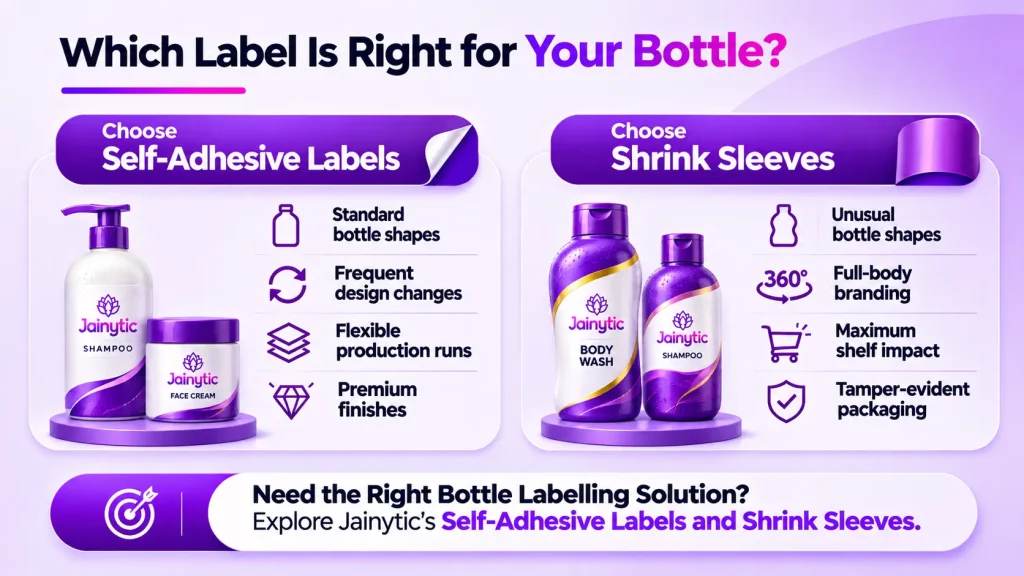
Self-Adhesive Labels vs Shrink Sleeves: A Simple Decision Guide
| Choose self-adhesive labels if… | Choose shrink sleeves if… |
| Your bottle has a clear, stable label panel. | Your bottle has complex curves or contours. |
| You need frequent SKU or artwork changes. | You want full-body 360-degree graphics. |
| You want front, back or partial-wrap labeling. | You need the branding to continue around the complete pack. |
| You already use pressure-sensitive label applicators. | You have or plan to install sleeve application and heat-shrink equipment. |
| You need premium label finishes in a defined area. | Maximum shelf impact is a key objective. |
| You want flexible short-to-high volume production. | You want integrated cap or neck tamper evidence. |
How Jainytic Helps You Choose the Right Bottle Label
At Jainytic Packaging, the label format is selected around the packaging application, not just the artwork.
Jainytic manufactures both self-adhesive labels and shrink sleeves, which allows brands to compare the two options based on bottle material, bottle geometry, production volume, required print coverage, application equipment, exposure conditions, finishing needs and budget.
Self-adhesive solutions are available across multiple substrates and adhesive grades for different packaging surfaces and production environments. Shrink-sleeve solutions can provide full-body coverage for complex bottle shapes and applications where shelf visibility and tamper evidence are important.
Testing the decoration on the actual bottle before full production remains essential, especially for low-surface-energy plastics, curved containers and demanding storage environments.
Final Verdict: Which Is Better for Plastic Bottles?
If you need flexibility, easy SKU changes, a defined label panel and straightforward application, self-adhesive labels are usually the better fit.
If you need 360-degree branding, strong contour conformity, unusual bottle shapes or integrated tamper-evident coverage, shrink sleeves are often the better option.
The strongest packaging decision is not to choose one technology because it is popular. It is to match the label format to the bottle, the production line and the way the product will actually be sold and used.
That is what turns a label from decoration into a packaging solution.
Frequently Asked Questions
They are better when the bottle has a suitable label panel, the brand needs flexible production and SKU changes, and full-body coverage is not required. Shrink sleeves are often better for complex bottle shapes and 360-degree graphics.
Not automatically. Both can be engineered for moisture, abrasion, temperature and chemical resistance. Performance depends on the selected film, adhesive where relevant, inks, coatings, bottle material and use environment.
Both formats can work well on PET. Self-adhesive labels are practical for conventional label areas and flexible production, while shrink sleeves are useful for full-body decoration and highly contoured bottle designs.
Self-adhesive labels are suitable when an adhesive designed for low-surface-energy plastic is used and the bottle provides a stable label area. Shrink sleeves can be advantageous when the HDPE bottle is highly contoured or needs near full-body coverage.
The main decorated body of a shrink sleeve typically conforms through heat shrinking rather than pressure-sensitive adhesive. The exact sleeve construction and application system should be selected for the container and production process.
Yes. A sleeve can be designed to extend over the neck or cap so opening the pack visibly breaks or disturbs the sleeve.