
The Best HDPE Label Is the One That Stays Attached Through Real Use
An HDPE container can look simply, but its surface creates one of the most common labeling challenges in rigid plastic packaging.
A label may look perfect immediately after application. Then the edges begin to lift. The label bubbles after filling. It loosens in storage. Or exposure to oil, chemicals, moisture, heat, or outdoor conditions makes the printed surface difficult to read.
The problem is often not the printing. It is the relationship between the HDPE surface, label material, adhesive, container shape, product, and application environment.
So, what type of label works best on HDPE containers?
For many standard applications, a film-based pressure-sensitive label with an adhesive formulated for low-surface-energy plastics is one of the most practical choices. For demanding industrial use, full-body decoration, or permanent branding, shrink sleeves and in-mold labels can be stronger alternatives.
The correct choice depends on how the container will be filled, handled, stored, transported, and used.
Why HDPE Containers Need a Different Labeling Approach
HDPE, or high-density polyethylene, is widely used for rigid packaging because it is strong, lightweight, moisture resistant, and suitable for products ranging from household cleaners and lubricants to agrochemicals, industrial chemicals, food products, and personal care formulations.
But HDPE has relatively low surface energy.
That matters because an adhesive must spread across, or “wet out,” the container surface to create reliable contact. General-purpose adhesives that perform well on glass, metal, or higher-energy plastics may not create the same bond on HDPE.
This is why simply choosing a “strong adhesive” is not enough.
The better question is: Which label construction will bond to this exact HDPE container and remain readable and secure throughout the product’s actual lifecycle?
Once that is clear, the choice between self-adhesive labels, shrink sleeves, in-mold labels, and other formats becomes easier.
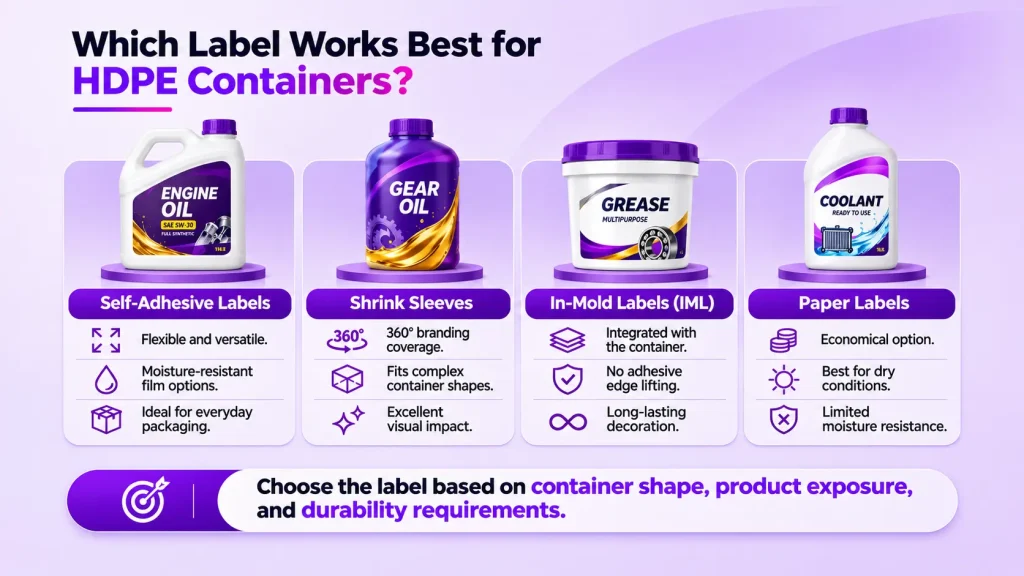
What Are the Best Label Options for HDPE Containers?
1. Film-Based Self-Adhesive Labels: A Flexible Choice for Many HDPE Packs
Pressure-sensitive or self-adhesive labels are one of the most versatile options for HDPE bottles, jars, drums, and jerry cans.
For HDPE, film face materials such as polypropylene (PP) or polyethylene (PE) are often more suitable than unprotected paper when the pack will face moisture, chemicals, oils, abrasion, or frequent handling.
The critical component is the adhesive. The adhesive should be selected specifically for low-surface-energy plastic rather than assumed to work because it is described as permanent.
- Strong branding and colour reproduction
- Variable shapes and die-cut sizes
- Barcode, QR code, batch, and product information
- Resistance to moisture and handling
- Compatibility with automated label application
- Flexibility for different order volumes and SKUs
This format is particularly useful when brands need a conventional front, back, or wraparound label without changing the container mould.
Best suited for: FMCG packs, personal care products, lubricants, household chemicals, automotive products, industrial containers, and other HDPE packaging where the label area is reasonably smooth and suitable for adhesive application.
2. Shrink Sleeves: Better When Coverage and Container Shape Matter
Shrink sleeves do not depend on pressure-sensitive adhesive across the main decorated area. Instead, the printed sleeve is placed around the container and shrunk to conform to its shape.
That makes shrink sleeves useful when an HDPE container has curves, contours, large branding areas, or a shape that makes conventional label placement difficult.
They can also provide near 360-degree decoration, giving brands more printable area for product communication and stronger shelf visibility.
- The container shape is highly contoured
- Large graphic coverage is required
- A conventional label would need to cross difficult curves
- Moisture or product contact makes exposed label edges a concern
- The brand wants full-body visual impact
However, sleeve design must account for distortion during shrinking, container geometry, seam position, and application conditions.
Best suited for: consumer-facing bottles and containers that need full-body branding, complex graphics, or coverage around curved surfaces.
3. In-Mold Labels: Best for Permanent, Integrated Decoration
In-mold labeling (IML) is fundamentally different from applying a label after an HDPE container has already been manufactured.
The printed label is placed into the mould and becomes integrated with the plastic container during moulding. The decoration therefore becomes part of the container rather than a separate adhesive label added later.
- No adhesive edge lifting
- High resistance to moisture and repeated handling
- A clean, integrated appearance
- Long-term graphic durability
- Reduced risk of labels peeling during use
- Potential mono-material advantages when compatible label and container materials are selected
The trade-off is production flexibility. IML must be planned with the container manufacturing process, mould, label dimensions, and automation. It is not normally the easiest solution for brands that already have finished containers and simply need labels applied afterward.
Best suited for: high-volume packaging programs, durable tubs and containers, and applications where long-term integrated branding is a priority.
4. Paper Labels: Suitable Only for Controlled Applications
Paper can still be used on some HDPE containers, but it should not be treated as the default simply because it is economical or easy to print.
Unprotected paper is more vulnerable to water, oils, chemicals, tearing, scuffing, and humidity. If the product will be stored indoors in dry conditions and the label has minimal exposure to moisture or aggressive substances, a suitable paper construction may work.
For more demanding HDPE applications, a film label or protected paper construction is usually safer.
Best suited for: controlled, dry environments where appearance and cost requirements justify paper and the label has been tested on the actual pack.
The Adhesive Is Often More Important Than the Face Material
A premium film label can still fail if the adhesive is wrong.
HDPE’s low surface energy makes adhesive selection central to label performance. A general-purpose adhesive may appear secure after application but begin to lift after storage, temperature changes, flexing, or handling.
For pressure-sensitive HDPE labels, evaluate:
- Initial tack: How quickly does the label grip the container after application?
- Ultimate adhesion: Does bond strength build sufficiently over time?
- Low-surface-energy compatibility: Is the adhesive designed to wet out and bond to polyethylene surfaces?
- Temperature range: Will the label be applied or stored in hot, cold, or fluctuating conditions?
- Chemical resistance: Could oils, solvents, detergents, pesticides, lubricants, or the packaged product contact the label?
- Moisture resistance: Will the pack face humidity, condensation, washing, or outdoor exposure?
- Container flexing: Will squeezing, stacking, or transport cause the HDPE wall to flex?
An adhesive should be selected from the actual application conditions, not from a generic “permanent” description.
How Container Shape Changes the Label Choice
HDPE containers are available in straight-sided bottles, jars, tubs, drums, and jerry cans, as well as shapes with handles, ribs, recessed panels, tapers, and compound curves.
A flat label prefers a stable, smooth labeling panel.
If a pressure-sensitive label is forced over a sharp curve, rib, textured area, or recessed transition, it can create tension that encourages edge lifting or bubbling.
Before finalizing the label, check:
- Available flat or near-flat labeling area
- Surface texture
- Curvature and taper
- Recessed or raised moulded features
- Handle position
- Label edge placement
- Application direction
- Whether the container flexes when filled, stacked, or squeezed
If the usable panel is limited, a smaller self-adhesive label, a sleeve, or an integrated IML solution may perform better than simply increasing adhesive strength.
Film Labels vs Paper Labels on HDPE Containers
| Feature | Film Label | Paper Label |
| Moisture resistance | High with suitable construction | Lower unless protected |
| Chemical/oil resistance | Can be engineered for demanding exposure | More limited |
| Flexibility | Better for some squeezable or curved packs | Generally lower |
| Durability | Strong for handling and abrasion | Depends heavily on coating/lamination |
| Premium print options | Wide range | Wide range |
| HDPE adhesion | Depends on LSE-compatible adhesive | Depends on LSE-compatible adhesive |
| Best use | Industrial, FMCG, chemical, personal care, automotive | Controlled dry applications |
The face material does not solve adhesion by itself. Both constructions still need an adhesive compatible with HDPE when they are pressure-sensitive labels.
Which Label Works Best for Different HDPE Applications?
For household cleaners and FMCG products
A durable PP or PE self-adhesive label is often a practical starting point. The construction should tolerate moisture, repeated handling, and any expected product splash.
For lubricants and automotive products
Use a film label with adhesive and print protection designed for oil, grease, chemicals, abrasion, and temperature variation. The label should remain readable even when the container is handled in workshops or storage areas.
For agrochemical and chemical jerry cans
Durability becomes more critical. Film-based pressure-sensitive labels, shrink sleeves, or IML may be considered depending on container design and manufacturing setup. The label system should be evaluated for chemical exposure, UV, outdoor storage, rough transport, and required safety information.
For personal care and cosmetic containers
Film labels can provide moisture resistance and clean print quality while supporting clear, white, matte, gloss, metallic, or other brand effects. The adhesive still needs to match the HDPE surface and the formulation’s exposure conditions.
For food-grade tubs and rigid packs
The label choice depends on storage temperature, moisture, handling, food-contact packaging requirements, and the container manufacturing process. IML can be attractive for high-volume integrated decoration, while self-adhesive film labels offer more post-moulding flexibility.
Common Reasons Labels Fail on HDPE Containers
Choosing the right label format is only part of the job. Failures can also occur when the application process is not controlled.
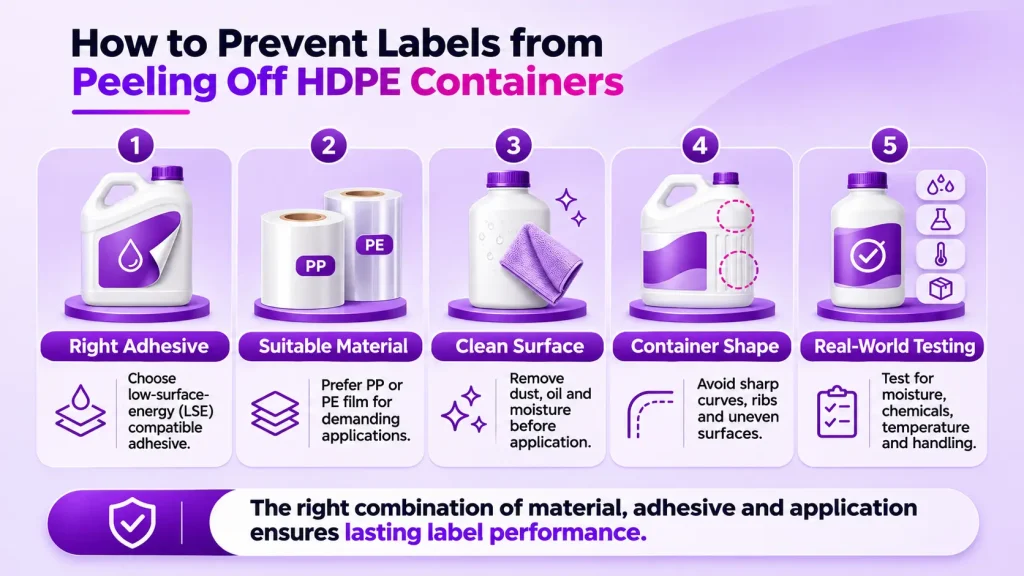
- Using an adhesive not designed for low-surface-energy plastic.
- Applying labels over mould-release residue, dust, oil, or moisture.
- Labeling a highly curved or textured area.
- Applying the label at a temperature outside the adhesive’s recommended range.
- Filling or handling the container before the adhesive has developed adequate bond.
- Using a rigid label on a container that flexes.
- Exposing an unsuitable face material or ink system to chemicals, oil, water, or UV.
- Assuming one label specification will work across different HDPE grades, shapes, or suppliers without testing.
A label that survives a five-minute sample check is not necessarily validated for production.
How to Test a Label Before Full Production
The most reliable label is the one tested on the actual HDPE container.
Before approving a production run, test samples under conditions that reflect real use.
Check the label:
- Immediately after application
- After 24 to 72 hours of dwell time
- After filling
- After expected storage temperatures
- After transport or stacking
- After exposure to moisture, oil, or relevant chemicals
- After squeezing or flexing, if applicable
- After outdoor or UV exposure when relevant
Inspect edge lifting, bubbling, tunneling, wrinkling, ink damage, barcode readability, label movement, and adhesive residue.
For automated lines, also test dispensing, application speed, label placement, and liner performance.
How to Choose the Right Label for Your HDPE Container
Use this decision sequence:
- Choose a low-surface-energy-compatible self-adhesive film label when you need flexible post-moulding labeling, multiple SKUs, conventional label panels, and durable everyday performance.
- Choose a shrink sleeve when you need extensive graphic coverage or must decorate a container whose shape is difficult for a flat pressure-sensitive label.
- Choose IML when you need integrated, long-life decoration and can coordinate the label with the container moulding process.
- Consider paper only when the pack will operate in controlled conditions and testing confirms that moisture, chemicals, handling, and appearance requirements can be met.
The final specification should always be based on the exact container, product, filling process, storage environment, application equipment, and desired shelf life.
How Jainytic Helps Brands Label HDPE Containers
At Jainytic Packaging, HDPE labeling is approached as a complete packaging system rather than a choice of sticker material alone.
Jainytic manufactures self-adhesive labels, shrink sleeves, in-mold labels, security labels, multilayer labels, and rigid containers including HDPE jars and jerry cans.
For an HDPE labeling project, the selection process can consider the container material and shape, label panel, product chemistry, storage conditions, required durability, artwork, print method, application process, and order volume.
This helps brands select a label construction that is designed not only to look correct at application, but to continue performing through filling, distribution, storage, retail, and end use.
Final Thoughts: The Best Label Depends on the Entire HDPE Pack
There is no single label type that is automatically best for every HDPE container.
For many applications, a film-based self-adhesive label paired with an adhesive engineered for low-surface-energy plastic provides an effective balance of durability, print flexibility, and production convenience.
For complex shapes or full-body branding, shrink sleeves can offer better coverage. For permanent integrated decoration, IML can remove the adhesive interface altogether.
The key is to stop treating the label and container as separate decisions.
HDPE surface characteristics, adhesive chemistry, face material, container shape, product exposure, storage, and application method all influence performance.
The best HDPE label is the one proven to stay attached, readable, and visually consistent through the product’s real journey.
Frequently Asked Questions
Film-based pressure-sensitive labels using an adhesive specifically formulated for low-surface-energy plastics are a strong choice for many HDPE applications. The exact adhesive should be validated on the actual container and under real storage and use conditions.
HDPE has low surface energy, which makes it harder for standard adhesives to wet out and form a strong bond. Surface contamination, curves, temperature, flexing, moisture, and chemical exposure can make the problem worse.
Yes. PP film labels are commonly considered for durable plastic packaging because they can provide moisture resistance, print quality, and good handling performance. They still require an adhesive suitable for the specific HDPE surface.
Yes, in controlled applications. However, paper is generally more vulnerable to moisture, oil, chemicals, abrasion, and tearing. A film construction may be more appropriate for demanding environments.
Not universally. Shrink sleeves are useful for complex shapes and large graphic coverage, while self-adhesive labels provide flexible application and can be more practical for standard label panels and multiple SKUs.
It can be. IML integrates the label during the moulding process and can provide durable, peel-free decoration. It is best considered when the label and container manufacturing process can be planned together.