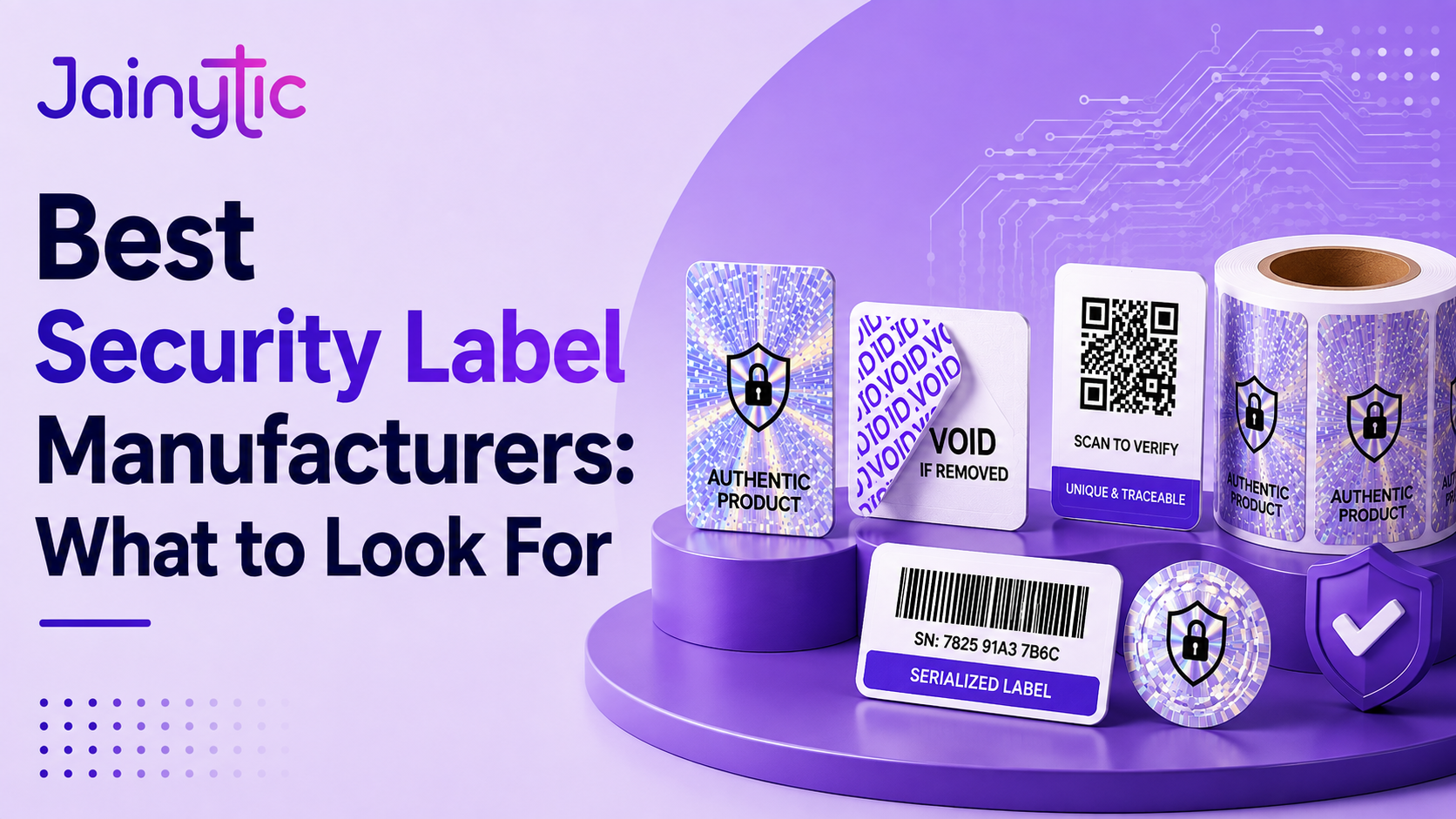
The Label That Protects Your Brand Before the Product Is Opened
A customer picks up your product from a shelf. The packaging looks genuine. The logo looks correct. The bottle, jar, carton, or container seems untouched.
But how will they know it is actually yours?
That is where security labels matter.
Many brands think about product protection only after duplicate products enter the market, retailers complain, or customers start questioning authenticity. By then, the damage is already visible.
The right security label proves authenticity, shows tampering, supports tracking, and gives your sales network a faster way to verify products. That is why choosing the right security label manufacturers is not just a printing decision. It is a brand protection decision.
So, what should you look for before selecting a label partner? Let us break it down.
The Problem with Ordinary Labels
Ordinary labels identify a product. Security labels protect it.
A standard printed label can show the product name, ingredients, batch details, barcode, and design. But if it can be copied easily, removed cleanly, or duplicated without traceability, it cannot protect your product from counterfeiting or misuse.
For FMCG, cosmetics, liquor, pharma, automotive, agro chemicals, electronics, lubricants, and industrial goods, the label must do more than look good. It must create proof.
What a Good Security Label Should Do
Before comparing vendors, first understand what your product needs.
- Prove that the product is genuine.
- Show visible evidence if the product has been opened or tampered with.
- Support batch tracking, serialization, or supply chain verification.
- Make duplication difficult for counterfeiters.
- Stay durable during handling, transport, moisture, heat, and storage.
- Fit naturally with the packaging design.
The best security label manufacturers do not sell one standard label to every brand. They study the product surface, risk level, packaging material, and verification needs before recommending a solution.
Security Label Options: What Are You Really Choosing?
Most businesses compare labels only by price. That is the wrong starting point. You should compare them by purpose.
| Security Layer | Best Use | Main Advantage | Limitation |
| Hologram Label | Visible brand authentication | Hard to copy and easy to recognize | May need another layer for tracking |
| VOID Label | Tamper evidence | Shows clear mark when removed | Not enough for full anti-counterfeit verification |
| Serialized QR Code | Digital verification and tracking | Allows unique product-level authentication | Needs backend system and scan logic |
| Multi-Layer Security Label | High-risk products | Combines visual, physical, and digital protection | Requires better planning and precision |
Hologram Labels: Best for Visible Authenticity
Hologram labels are one of the most recognized product security layers. They create a visual authentication effect that is difficult to reproduce with regular printing. For retail products, this helps customers, distributors, and retailers quickly identify the original product.
Good hologram label manufacturers can customize patterns, brand marks, numbering, tamper effects, and finishing based on the required protection level. Their biggest advantage is instant visibility. Their limitation is that they work best when paired with controlled supply, serialization, or QR verification.
VOID Labels: Best for Tamper Evidence
VOID labels are used when the main risk is product opening, seal breaking, warranty misuse, or unauthorized access. When someone tries to remove the label, it leaves a visible VOID pattern or residue on the surface.
This makes them useful for electronics, pharma packs, warranty seals, confidential packaging, containers, and high-value goods. The advantage is clear tamper evidence. The limitation is that a VOID label may not prove whether the product itself is original unless it is combined with another authentication layer.
Serialized QR Codes: Best for Tracking and Verification
Serialized QR codes add a digital layer to product security. Each product can carry a unique code linked to batch data, warranty details, product information, or authentication systems. GS1 Digital Link also shows how QR codes can connect packaging to richer online product information and better supply chain data sharing.
This is useful for brands that want product-level traceability and consumer verification. The limitation is that QR security depends on strong serialization logic, database management, and copy detection rules. A printed QR code alone is not enough.
How to Choose the Right Security Layer
The right choice depends on the risk you are trying to reduce.
- If your biggest issue is fake products, choose hologram labels or multi-layer labels.
- If your biggest issue is opened or replaced products, choose VOID or tamper-evident labels.
- If your biggest issue is distributor misuse or grey-market movement, choose serialized QR codes.
- If your product is high-risk or high-value, combine hologram, tamper evidence, and serialization.
Security works best when layers support each other. A hologram builds visual trust. A VOID label shows tampering. A serialized QR code adds traceability. Together, they create stronger protection than any single label can provide.
What to Look for in the Best Security Label Manufacturers
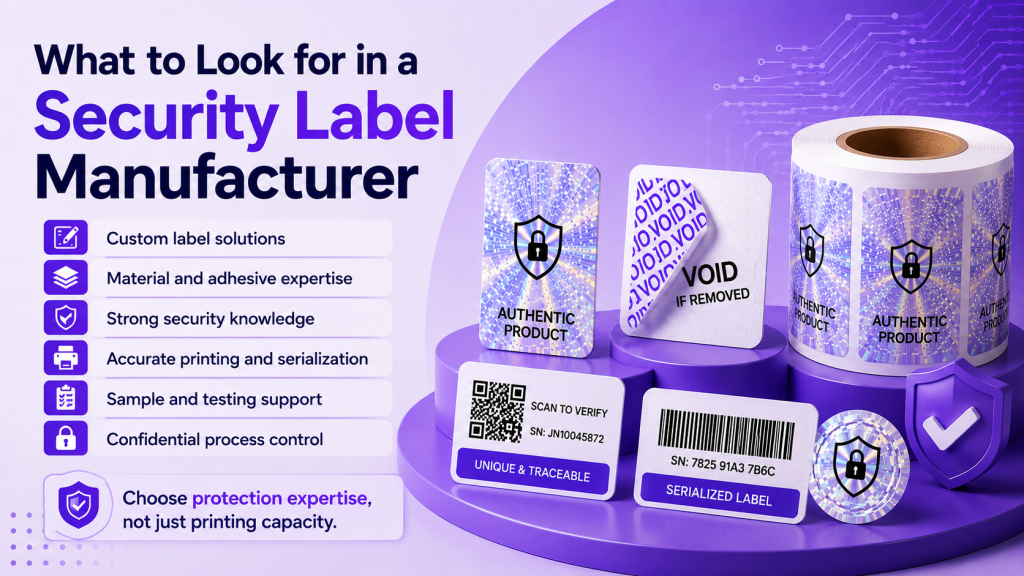
1. Customization Capability
Avoid vendors who only offer fixed templates. Your label should match your product shape, surface, storage condition, and brand design. Size, adhesive, material, holographic effect, numbering, and tamper pattern all matter.
2. Knowledge of Security Layers
A reliable vendor should explain when to use hologram, VOID, QR, destructible, tamper-evident, or multi-layer labels. If a manufacturer pushes only one option without studying your product, that is a red flag.
3. Strong Material and Adhesive Selection
Glass, HDPE, PET, metal, cartons, painted surfaces, and curved containers all behave differently. A good label partner recommends adhesive and material based on real application conditions, not just artwork size.
4. Print Accuracy and Batch Consistency
Security printing needs precision. Weak finishing, poor registration, low-quality holographic effects, and inconsistent numbering reduce trust. Always ask for samples before bulk production.
5. Serialization and Data Handling
If you need QR codes, barcodes, batch numbers, or variable data, the manufacturer must handle data accurately and securely. Serialization errors can affect tracking, verification, and distributor confidence.
6. Confidentiality and Process Control
Security labels involve sensitive brand assets. ISO 14298 defines requirements for security printing management systems, which shows why controlled processes and customer security requirements matter in this category.
Why Location Matters for Delhi NCR Brands
For businesses in Noida, Delhi, Gurugram, Faridabad, Ghaziabad, and nearby industrial areas, working with security label manufacturers in Delhi NCR can make the process faster and more practical.
Local coordination helps with sample approvals, urgent print runs, packaging trials, material testing, and faster delivery. This is especially useful when the label must be tested on bottles, jars, cartons, HDPE containers, or curved product surfaces before final production.
The right security label manufacturers in Delhi NCR should support design customization, material guidance, and production consistency, not just low-cost printing.
Red Flags to Avoid
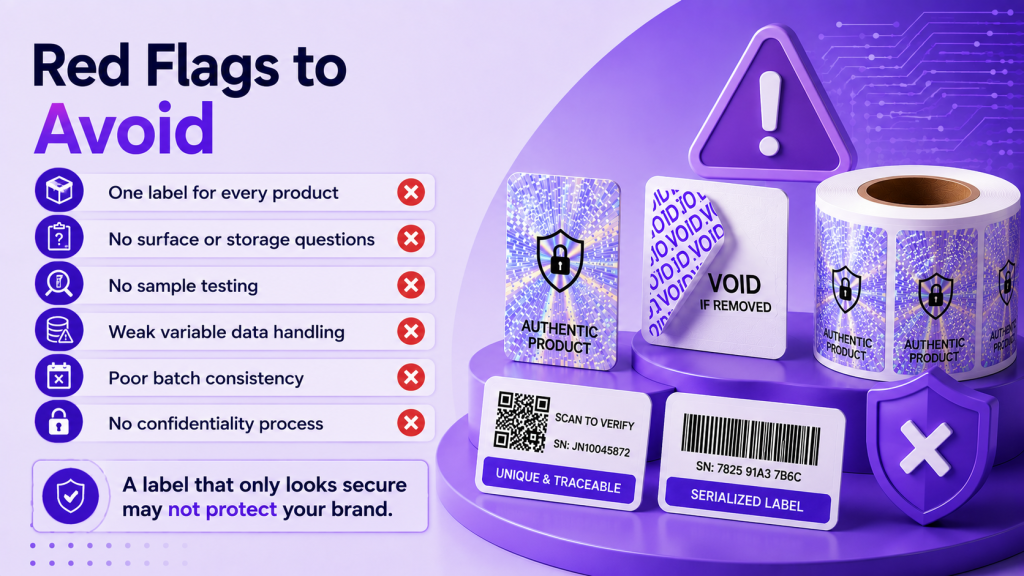
- They quote without asking about product surface or storage conditions.
- They cannot explain the difference between hologram, VOID, and serialized labels.
- They offer no sampling or testing process.
- They treat security labels like ordinary stickers.
- They cannot manage variable data accurately.
- They do not discuss confidentiality or artwork control.
A poor security label can create a false sense of protection. It may look secure, but fail when copied, removed, exposed to moisture, or applied on the wrong surface.
How Jainytic Helps Brands Build Better Product Security
Jainytic helps brands create customized labels that match product risk, packaging format, and brand presentation. From hologram labels and tamper-evident labels to serialized QR code labels, self-adhesive labels, shrink sleeves, wet glue labels, tag labels, and HDPE container labeling solutions, Jainytic focuses on practical security that works on real packaging.
As one of the trusted security label manufacturers in Delhi NCR, Jainytic supports brands that need more than basic printing. The team helps businesses select the right material, adhesive, printing method, finish, and security layer for their product category.
Whether you need visible authentication, tamper evidence, QR-based verification, or a combination of all three, Jainytic can help you develop a label system that protects your product and strengthens customer trust.
Final Thought: The Best Security Label Is Built Around Your Risk
There is no single best security label for every product. A hologram may be perfect for visible authentication. A VOID label may be better for tamper evidence. A serialized QR code may be stronger for traceability.
The real decision is not which label looks more advanced. The real decision is which label solves your product’s biggest security risk.
That is why choosing the right security label manufacturers matters. The right partner will not just print labels. They will help protect your product, your supply chain, and your brand reputation.
Frequently Asked Questions
Security label manufacturers design and produce labels that help protect products from counterfeiting, tampering, duplication, and unauthorized access. These labels can include holograms, VOID effects, tamper-evident materials, serialized QR codes, barcodes, destructible films, and other authentication features.
Start by identifying your main risk. If your issue is fake products, consider hologram or multi-layer labels. If your issue is package opening, choose VOID or tamper-evident labels. If your issue is tracking and verification, serialized QR codes are useful.
Hologram labels and VOID labels solve different problems. Holograms help prove authenticity through visual features. VOID labels show visible tampering when removed. Many brands use both when they need anti-counterfeit protection and tamper evidence together.
Brands in Delhi NCR benefit from faster sampling, easier coordination, quicker production support, and practical packaging trials. For manufacturers in Noida, Delhi, Gurugram, Faridabad, and Ghaziabad, local support can make security label development faster and more reliable.
Yes. Security labels can be customized by material, adhesive, size, shape, print design, holographic effect, QR code, numbering, and tamper pattern. Different industries such as FMCG, pharma, cosmetics, liquor, electronics, automotive, and agrochemicals often need different security label structures.