
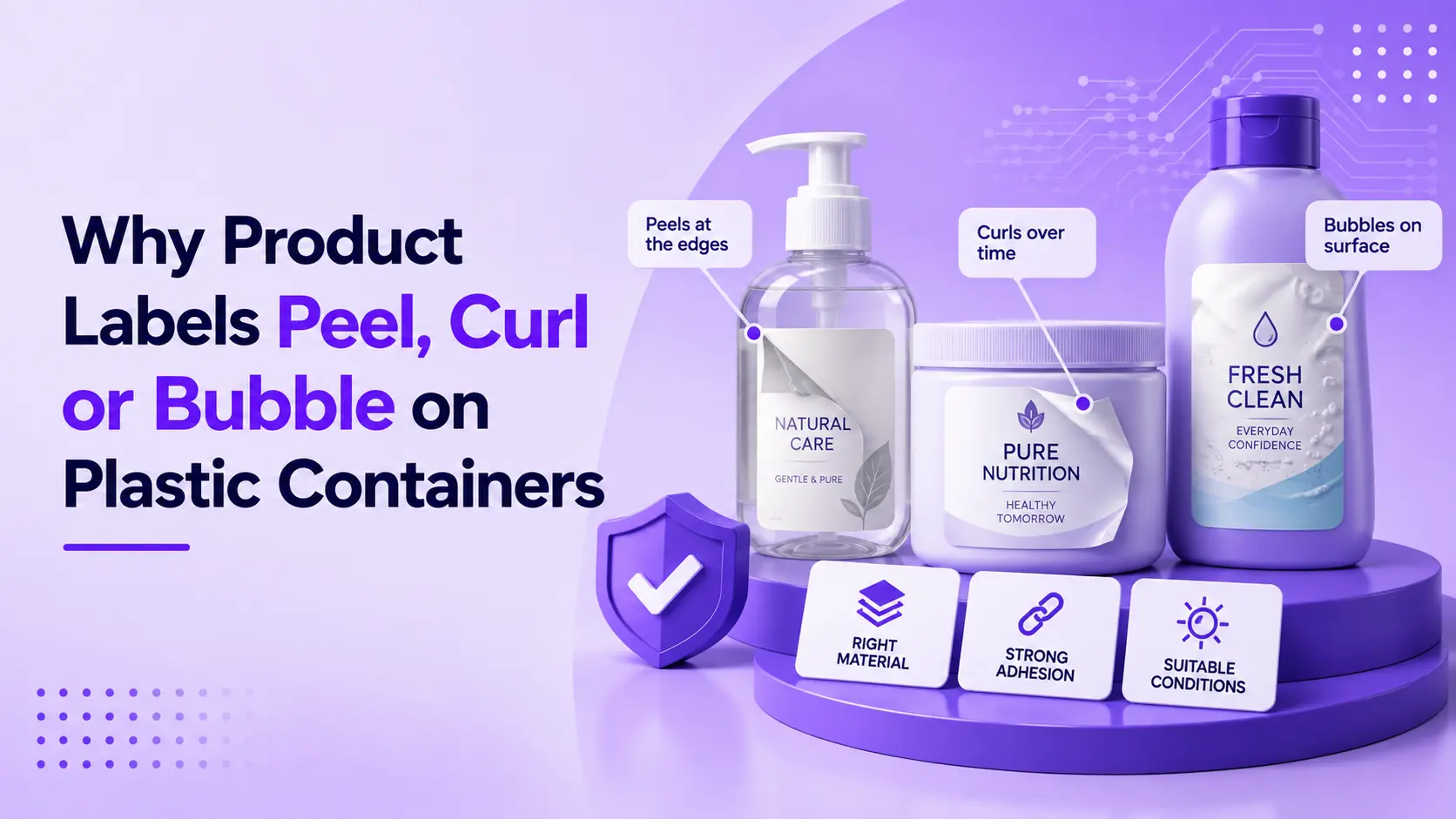
A label rarely fails because it is simply not sticky enough. It usually fails because the plastic, adhesive, label material, container shape, or application process was never treated as one complete system.
The Label Failure Customers Notice First
A customer picks up a shampoo bottle, cosmetic jar, lubricant container, food tub, or chemical pack from a shelf.
The product may be properly filled and professionally designed. But one label edge has lifted, a bubble crosses the logo, or the label curls away when the bottle is squeezed.
The customer does not study the reason. They see a poorly packed, less trustworthy product.
For brands dealing with labels peeling off plastic containers, the problem affects presentation, readability, identification, and trust.
The Real Question Is Not Whether You Need a Stronger Adhesive
When labels begin lifting, the first reaction is often to ask for the strongest adhesive available.
That can be the wrong solution.
Aggressive adhesive may fail on contamination. Stiff paper may resist a tight curve. A label applied to a cold or wet pack may not develop the expected bond.
The better question is simple:
What is preventing this label construction from staying in contact with this specific plastic container?
Once the surface, shape, environment, and application conditions are understood, the reason for labels peeling off plastic containers becomes easier to identify.
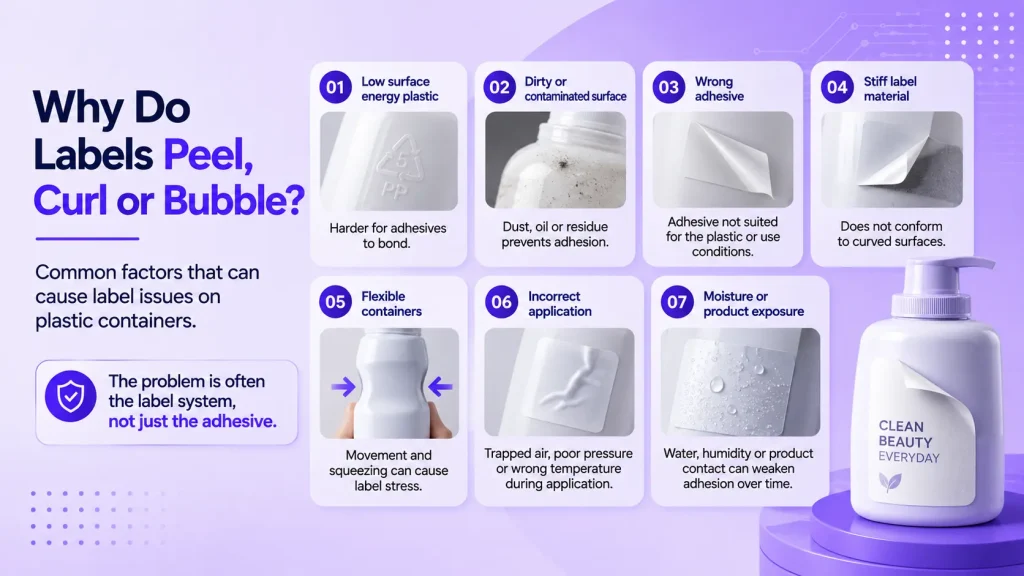
Why Do Labels Peel, Curl or Bubble?
Pressure-sensitive labels depend on the plastic, adhesive, facestock, dimensions, pressure, temperature, and bonding time working together.
Peeling starts at an edge. Curling occurs when material resists the curve or reacts to moisture. Bubbling forms when air, contamination, gases, or movement creates a raised area.
A label can look correct initially and fail during filling, transport, refrigeration, storage, or use. Labels peeling off plastic containers should be investigated as a packaging system problem, not only a printing defect.
1. The Plastic Has Low Surface Energy
Not every plastic provides the same bonding surface. HDPE and polypropylene can be more difficult to label because adhesives do not spread across them as easily as they do across higher surface energy materials.
Weak contact allows edges to lift during storage, squeezing, or temperature changes. Consider the exact resin, recycled content, finish, and moulding process instead of calling the pack only plastic.
2. The Surface Is Not Completely Clean
A container can look clean while carrying dust, oil, silicone, mould release agent, or processing residue. The adhesive then bonds to the contamination instead of the container.
Filling spills create the same problem. Product residue near the label area prevents reliable contact. Random labels peeling off plastic containers within one batch often indicate surface or handling variation.
3. The Adhesive Does Not Match the Application
General-purpose adhesives are not suitable for every plastic, temperature, chemical, or storage condition.
A rigid PET bottle, flexible HDPE pack, textured container, and refrigerated food tub create different demands. Some need higher initial tack; others need water, oil, chemical, cold, or heat resistance.
Adhesive selection should follow the actual container and product journey, not only cost or performance on another pack.
4. The Label Material Is Too Stiff for the Curve
A flat label naturally tries to remain flat. On a small bottle, tight corner, or compound curve, a thick or rigid facestock creates tension against the adhesive.
If tension exceeds the edge bond, the label flags or curls. A thin, conformable film may perform better than stiff paper on difficult curves.
Selecting a premium-looking material without checking conformability is a common reason for labels peeling off plastic containers.
5. The Container Flexes During Use
Shampoo, cleaner, oil, and personal care bottles are often squeezed repeatedly. The plastic changes shape, but a rigid label may not move with it.
This can create edge stress, wrinkles, tunnels, or bubbles, especially when a large label covers a flexible panel. Testing only an empty, untouched bottle does not represent customer use.
6. Application Conditions Are Incorrect
Pressure-sensitive adhesives need suitable temperature, pressure, and surface contact. When the container is too cold, the adhesive may remain firm and fail to flow into microscopic surface irregularities.
Condensation adds another barrier. Uneven pressure, trapped air, incorrect machine settings, or unstable bottles leave weak areas that become bubbles or lifted edges.
Application temperature should not be confused with service temperature. A label may survive refrigeration after bonding correctly but fail when first applied to a cold, wet pack.
7. Moisture, Product Exposure or Gases Affect the Label
Water, oil, solvents, and ingredients can enter from the edge or weaken unsuitable materials. Moisture can make paper expand, distort, or curl.
Some containers or filled products may also release or transmit gases over time. If the label cannot accommodate that movement, bubbles may appear after several days.
Delayed failures explain why labels peeling off plastic containers may not be visible during immediate production inspection.
Label Failure Symptoms and What They Usually Indicate
| Visible Problem | Likely Cause | First Check |
| Edges lifting | Weak adhesion or material memory | Plastic, adhesive and curve |
| Label curling | Moisture or stiff facestock | Material and storage |
| Large bubbles | Trapped air or pack movement | Pressure and flexibility |
| Random failures | Contamination or variation | Cleanliness and handling |
| Cold-store failure | Wet or cold application | Application temperature |
| Squeeze wrinkles | Poor conformability | Facestock, size and placement |
How Should Brands Test Labels on Plastic Containers?
Testing should use the actual production container. Small changes in resin, finish, additives, recycled content, or moulding can affect adhesion.
Apply labels under realistic line conditions and test filled packs through transport, moisture, temperature changes, spills, squeezing, and handling.
Inspect immediately, after 24 hours, and again after longer storage. Record the container batch, facestock, adhesive, application conditions, and failure pattern. This makes labels peeling off plastic containers easier to diagnose instead of relying on guesswork.
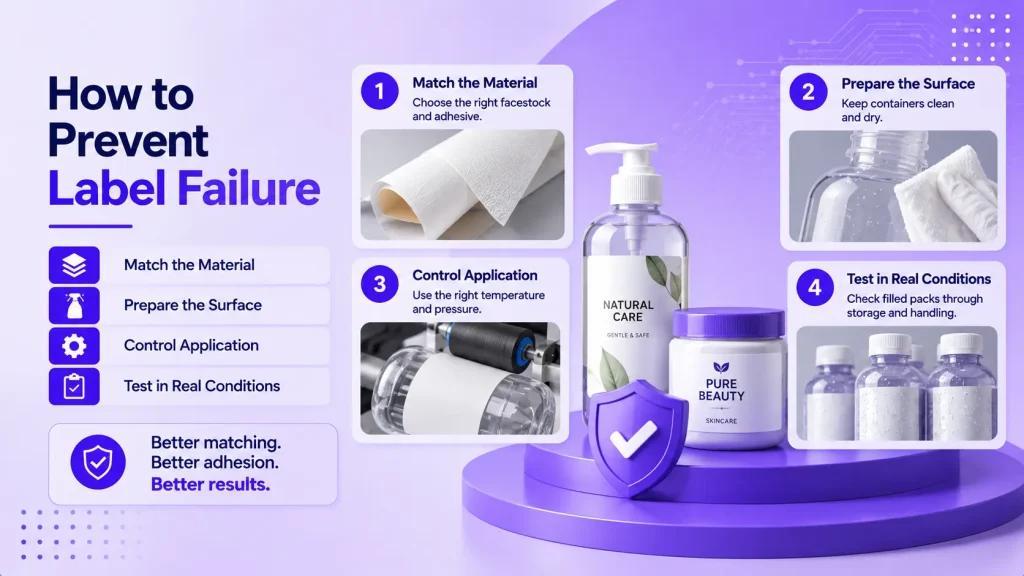
Which Label Construction Should You Use?
No single material or adhesive is best for every plastic container.
Rigid, smooth bottles may work with standard paper or film constructions. Flexible or low surface energy containers may need a conformable facestock and an adhesive developed for difficult plastics. Wet, oily, refrigerated, or chemical applications need additional resistance.
Label size and placement also matter. Large labels create more opportunity for flexing and trapped air, while tight curves increase edge stress. The best construction matches the plastic, shape, filling process, storage, and use conditions.
Where Different Industries Face These Problems
Personal care packs face water, oil, and squeezing. Food containers may experience refrigeration and condensation. Automotive, agrochemical, lubricant, and industrial packs may involve textured HDPE, chemicals, heat, and demanding transport.
The visible symptom may look similar, but the reason for labels peeling off plastic containers can change significantly by category.
How Jainytic Helps Prevent Label Failure on Plastic Containers
At Jainytic, labels are planned around the complete packaging application rather than artwork alone.
As a label manufacturer in Delhi NCR, Jainytic supports brands with self-adhesive labels, multilayer labels, shrink sleeves, security labels, and customised solutions for plastic containers.
The process begins with practical questions. Is the container PET, HDPE, PP, or another material? Is it rigid, flexible, smooth, textured, curved, or tapered? Will it face water, oil, chemicals, refrigeration, heat, friction, or repeated squeezing?
Jainytic then recommends suitable facestocks, adhesives, dimensions, printing protection, and application trials. Testing on the actual pack helps reduce the risk of labels peeling off plastic containers after filling or dispatch.
Final Thoughts: A Label Must Match More Than the Artwork
A good design attracts attention, but the label must remain flat, readable, and secure to protect that impression.
Peeling, curling, and bubbling usually indicate a mismatch between the plastic, adhesive, facestock, label size, environment, or application process.
The answer is not automatically stronger adhesive. It is a matched label system supported by realistic testing.
When every element works together, labels peeling off plastic containers can be prevented before they become a shelf-level brand problem.
Frequently Asked Questions
HDPE has relatively low surface energy, which can make adhesive contact more difficult. Surface contamination, container flexibility, and unsuitable adhesive selection can increase edge lifting.
Delayed bubbles may result from trapped air, moisture, contamination, temperature changes, container movement, or gases passing through the packaging system.
Sometimes, but not always. The facestock, container curve, cleanliness, application temperature, pressure, and product exposure must also be evaluated.
Film labels are often more moisture resistant and may conform better to flexible or curved packs. Paper can work well when the container and environment are suitable.
Identify the exact plastic, select a compatible adhesive and facestock, keep the surface clean and dry, control application conditions, and test filled packs through realistic storage and use.
Jainytic evaluates container material, surface, shape, environment, label construction, and application requirements before recommending a customised solution.