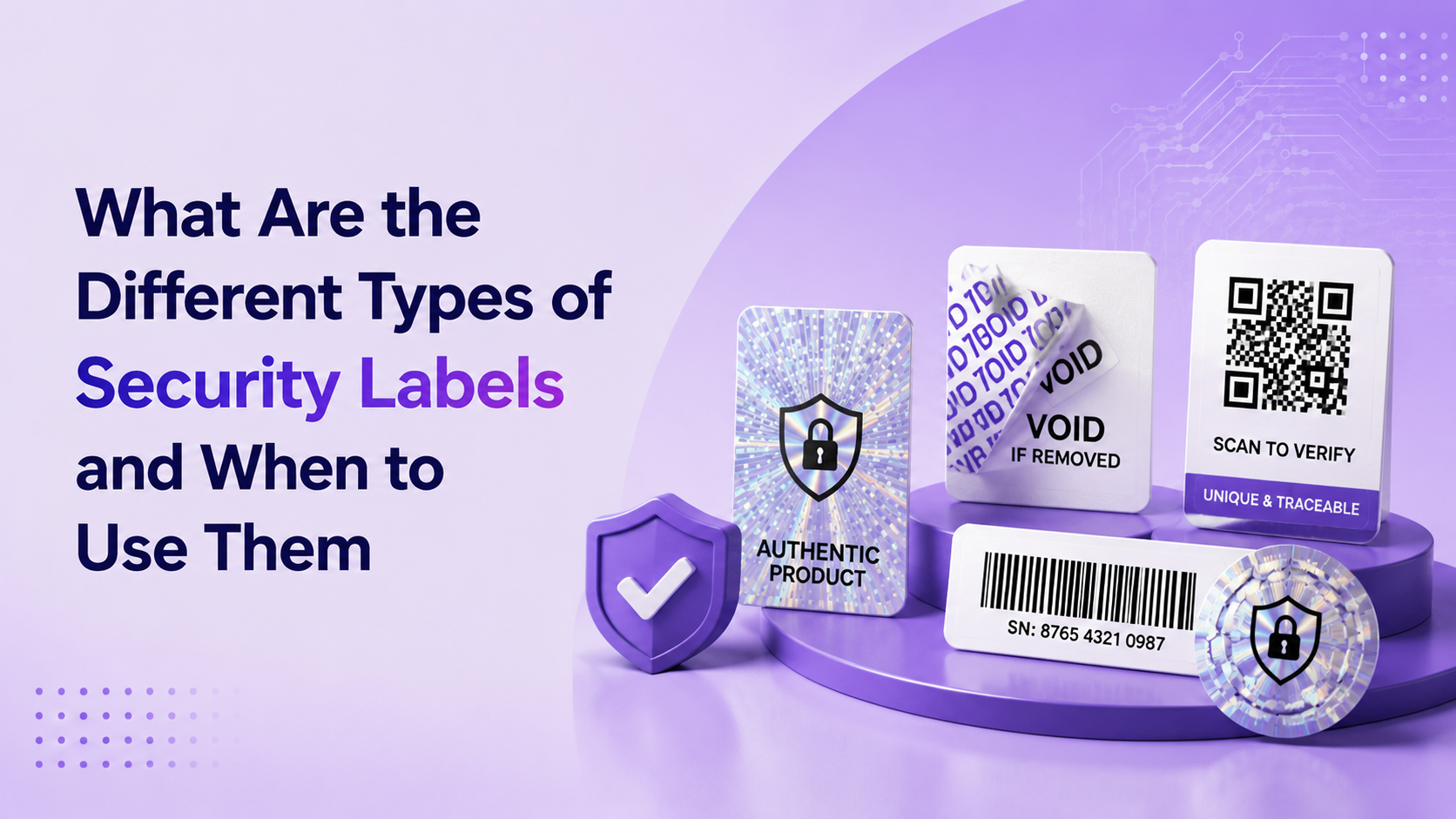
The right security label is not just a sticker. It is the first warning sign against counterfeiting, tampering, relabeling, and product misuse.
The Label That Decides Product Trust
A customer picks up your product from a shelf.
Before they read the ingredients, warranty details, batch number, or brand story, they notice one thing.
Does this product look genuine?
That first impression matters. In pharma, FMCG, cosmetics, electronics, automotive parts, liquor, agro products, and industrial goods, packaging is not only about design. It is also about protection.
A weak label can invite counterfeiting. A missing seal can make a product look opened. A removable sticker can be reused on a fake product. That is why brands work with experienced security label manufacturers who understand both packaging and risk.
But the confusion is real. Should you use a hologram label, a VOID label, a destructible label, a serialized QR code, a scratch code, or a security tape?
The answer depends on what you are trying to stop.
The Real Question Is Not Which Label Looks Premium
Many businesses choose security labels by appearance. That is the wrong starting point.
A hologram looks premium. A VOID label shows opening. A QR code creates digital verification. A destructible label prevents clean removal. A scratch label hides a one-time code. Each security layer solves a different problem.
So, the better question is simple:
Are you trying to stop product duplication, detect tampering, prevent warranty fraud, control distribution, protect cartons in transit, or give customers a way to verify authenticity?
Once the risk is clear, the label choice becomes clear too. Reliable security label manufacturers in Delhi NCR usually begin with this risk mapping before recommending a label type.
What Are Security Labels?
Security labels are specialized labels designed to protect products from duplication, tampering, unauthorized opening, label transfer, and fake distribution.
Unlike standard product labels, they include protective features such as holographic films, tamper-evident adhesives, VOID release patterns, fragile materials, unique serial numbers, QR codes, scratch panels, or customized security printing.
A normal label identifies the product. A security label protects the product.
For manufacturers, these labels help build customer trust, reduce fraud, support compliance, and give retailers or consumers a visible way to identify genuine products.
1. Hologram Labels
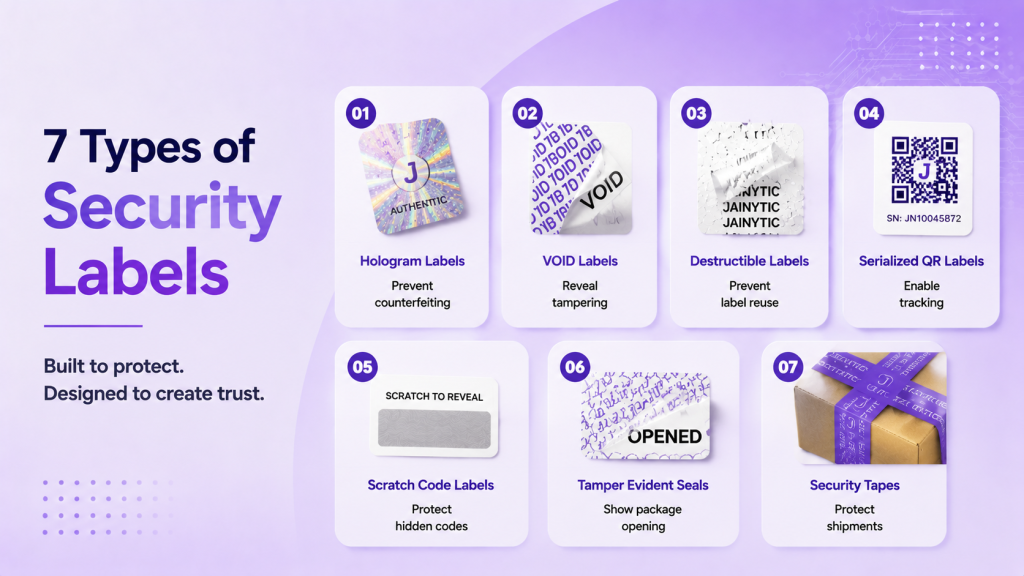
Hologram labels are one of the most common anti-counterfeit solutions. They use optical effects, color shifts, patterns, and light reflection to create a visible security layer that is difficult to copy with normal printing.
They are widely used on medicines, cosmetics, liquor bottles, electronics, certificates, spare parts, and premium FMCG products.
Use hologram labels when your main concern is brand imitation or product duplication.
Advantages: Strong visual authentication, premium appearance, difficult replication, easy customer recognition, and the option to combine with serial numbers or QR codes.
Limitations: A basic hologram alone may not be enough for high-risk products. For better protection, brands should use customized holograms with hidden features, numbering, tamper-evident adhesives, or digital verification.
2. VOID Labels
VOID labels are tamper-evident labels that reveal a hidden message when someone tries to remove them. The message may appear on the label, the product surface, or both.
They are useful for electronics, warranty seals, device packaging, pharma cartons, cosmetic boxes, and sealed access points.
Use VOID labels when your main concern is unauthorized opening.
Advantages: Clear tamper evidence, difficult reapplication, simple visual proof, and strong use in warranty protection.
Limitations: VOID labels mainly show that opening or removal was attempted. They do not verify product originality unless combined with hologram, QR, or serialization features.
3. Destructible Labels
Destructible labels are made from fragile material that breaks into pieces when removal is attempted. Instead of peeling off cleanly, the label tears, flakes, or cracks.
They are commonly used for asset labels, electronics, appliances, automobile parts, warranty seals, and high-value components.
Use destructible labels when you want to prevent genuine labels from being removed and reused on fake or unauthorized products.
Advantages: Prevents clean label transfer, provides visible damage, supports warranty protection, and works well on hard surfaces.
Limitations: These labels need proper surface and adhesive testing. Curved surfaces, rough textures, moisture, oil, and heat can affect performance.
4. Serialized QR Code Labels
Serialized QR code labels give each product a unique digital identity. When scanned, the code can verify authenticity, show product information, register warranty, track scan location, or connect the customer to a brand-owned page.
They are useful for pharma, FMCG, agro products, electronics, liquor, industrial goods, and consumer campaigns.
Use serialized QR labels when you need traceability and product-level verification.
Advantages: Unit-level tracking, smartphone scanning, digital authentication, consumer engagement, and supply chain visibility.
Limitations: A plain QR code can be copied. It becomes secure only when serialized, linked to a controlled backend, and preferably combined with physical security features.
5. Scratch Code Labels
Scratch code labels hide a unique code under a scratch-off layer. The customer or distributor scratches the panel and verifies the code through a website, SMS, app, or support system.
They are used for product authentication, promotional campaigns, loyalty programs, coupons, and warranty registration.
Use scratch labels when the code should stay hidden until purchase or authorized verification.
Advantages: Protects one-time codes, supports campaigns, works well for customer verification, and adds an interactive layer to packaging.
Limitations: The backend system must be strong. If codes are reused or poorly managed, the security value drops.
6. Tamper-Evident Seal Labels
Tamper-evident seal labels show whether a bottle, carton, pouch, cap, or container has been opened. They may tear, break, leave residue, or reveal a pattern when removed.
They are important for food, pharma, cosmetics, chemicals, lubricants, and products where safety depends on sealed packaging.
Use them when your product must reach the customer unopened.
Advantages: Simple proof of sealing, strong customer reassurance, useful against refilling, and suitable for many packaging formats.
Limitations: They require product-specific testing because adhesive behavior can change with surface texture, moisture, temperature, and handling conditions.
7. Security Tapes and Carton Seals
Security tapes protect outer cartons, shipping boxes, courier packs, and logistics packaging. They are useful when products move through warehouses, transporters, distributors, and retailers.
Use security tapes when you need shipment-level protection.
Advantages: Detects carton opening, protects bulk movement, supports warehouse control, and reduces transit-related tampering.
Limitations: It protects the outer package, not every individual product inside. High-value goods should use both carton-level and product-level labels.
Security Label Comparison
| Security Label Type | Best Used For | Main Advantage | Main Limitation |
| Hologram labels | Counterfeit prevention | Strong visual trust | Basic versions can be imitated |
| VOID labels | Tamper evidence | Shows removal attempt | No digital verification |
| Destructible labels | Label transfer prevention | Breaks on removal | Needs surface testing |
| Serialized QR labels | Traceability | Unit-level authentication | Needs secure backend |
| Scratch code labels | Hidden verification | Protects one-time codes | Depends on code control |
| Tamper-evident seals | Unopened product assurance | Shows package interference | Adhesive must match surface |
| Security tapes | Carton protection | Protects shipments | Does not secure each unit |
Which Security Label Should You Use?
Here is the simplest way to decide.
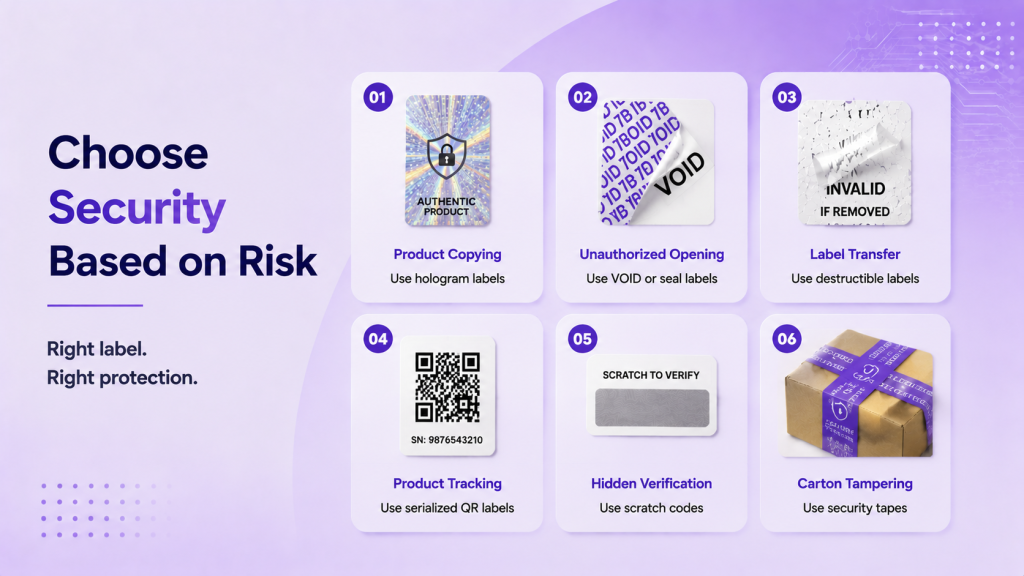
If your product is being copied, use hologram labels with customized security features. If your product is being opened, use VOID labels or tamper-evident seals. If genuine labels are being removed and reused, use destructible labels. If you need product-level tracking, use serialized QR labels. If you need hidden customer verification, use scratch code labels. If cartons are being opened in transit, use security tapes.
For many businesses, the strongest solution is not one label. It is a layered system. For example, a pharma brand may use a hologram label for visual authentication, a VOID seal for tamper evidence, and a serialized QR code for digital verification. This is why experienced security label manufacturers often recommend combining physical and digital security layers.
Where Different Industries Use Security Labels
Pharma brands use them for medicine authentication, batch visibility, and tamper evidence. Cosmetic brands use them to prevent refilling and fake product circulation. Electronics companies use them for warranty protection and access control. FMCG brands use them for promotional codes and consumer trust. Automotive and industrial brands use them for spare part verification. Liquor and beverage brands use them to reduce refilling and fake distribution.
This is why security label manufacturers in Delhi NCR are now supporting many sectors, not only pharma and electronics. Product security has become a packaging priority for every serious manufacturer.
How Jainytic Helps Brands Choose the Right Security Label
At Jainytic, security labels are designed around product risk, packaging surface, supply chain movement, and brand requirements.
As one of the trusted security label manufacturers, Jainytic supports businesses with hologram labels, VOID labels, tamper-evident labels, destructible labels, serialized QR code labels, scratch labels, security tapes, and customized brand protection solutions.
The process starts with practical questions. Is the product sold in retail stores? Does it move through distributors? Is counterfeiting common in the category? Does the product need warranty control? Should customers verify it online? Does the label need to survive moisture, oil, heat, friction, or cold storage?
Based on these answers, Jainytic recommends the right material, adhesive, printing method, security feature, and finishing option. For manufacturers searching for security label manufacturers in Delhi NCR, Jainytic provides solutions that balance protection, usability, cost, and brand presentation.
Final Thoughts: Security Labels Are Not Optional Anymore
Counterfeiting, tampering, refilling, relabeling, and warranty misuse are not small packaging issues. They directly affect customer trust, distributor confidence, and brand reputation.
The goal is not to choose the most expensive label. The goal is to choose the right security layer for the right risk.
Hologram labels build visual trust. VOID labels reveal opening. Destructible labels stop transfer. QR codes create traceability. Scratch labels protect hidden verification. Security tapes protect cartons. Together, they help brands build a stronger product protection system.
If your product is ready for market, its security layer should be ready too.
Frequently Asked Questions
Security labels are protective labels used to prevent counterfeiting, tampering, relabeling, refilling, or unauthorized opening. They may include holograms, VOID patterns, destructible materials, serialized QR codes, scratch panels, or tamper-evident adhesives.
Hologram labels are commonly used for anti-counterfeiting because they provide visible authentication and are difficult to copy with normal printing. For stronger protection, brands can combine holograms with serial numbers, QR codes, hidden features, or tamper-evident adhesives.
A brand should use VOID labels when it needs clear proof that a product, package, device, or access point has been opened. They are especially useful for electronics, warranty seals, pharma packs, cosmetics, and sealed product closures.
QR code labels are useful for authentication and traceability when each code is unique, serialized, and connected to a secure verification system. A plain QR code printed on every unit can be copied, so it works better when combined with physical security labels.
Choose a manufacturer that understands product risk, label materials, adhesives, printing quality, tamper-evident behavior, and industry use cases. The right partner should recommend labels based on whether your concern is counterfeiting, tampering, tracking, warranty misuse, or shipment security.
Jainytic helps brands select and manufacture security labels based on real product protection needs. From hologram labels and VOID labels to serialized QR code labels, scratch labels, tamper-evident seals, and security tapes, Jainytic supports manufacturers that need reliable and customized security labeling solutions.