
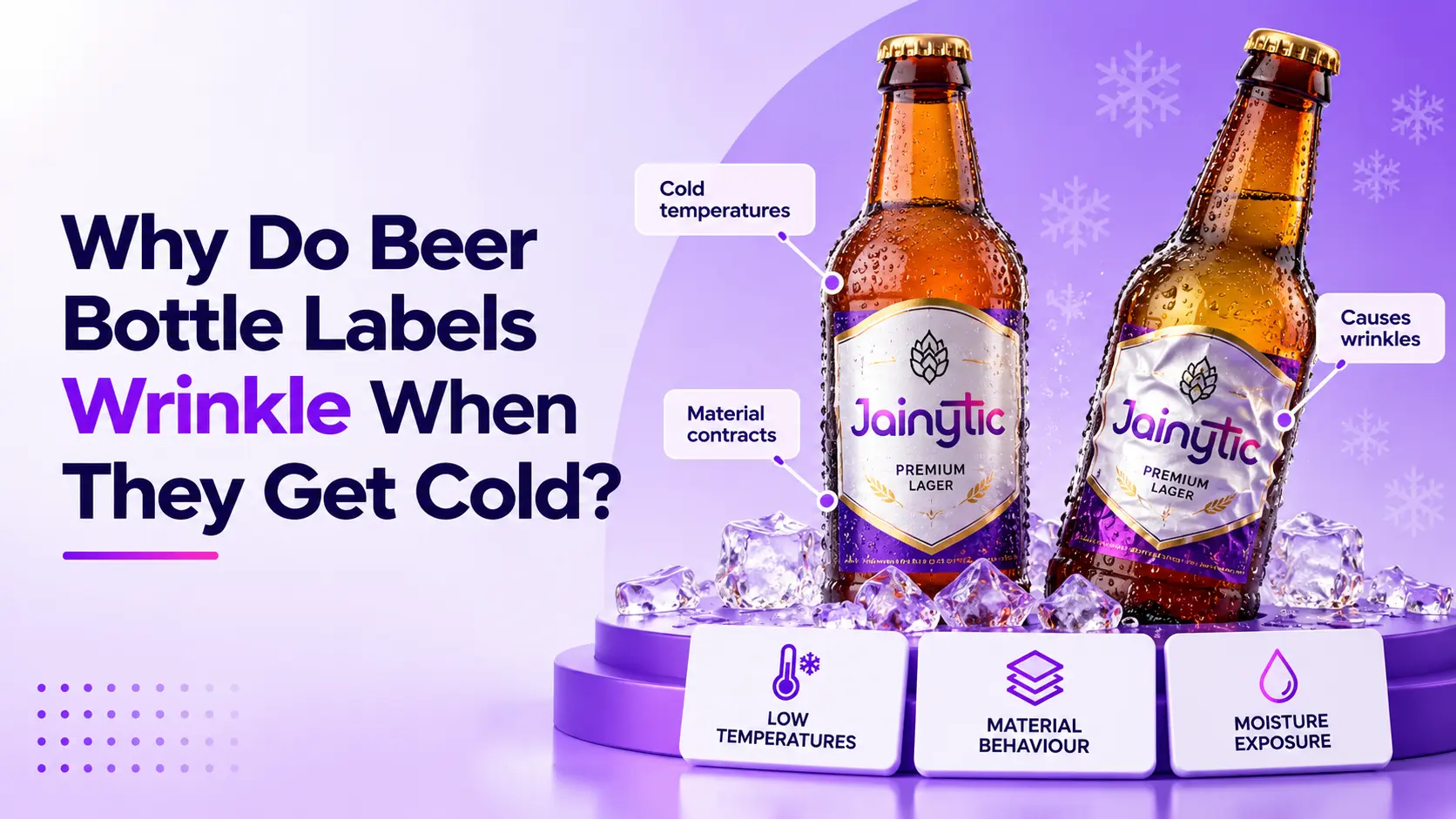
The Beer Is Supposed to Get Chilled. The Label Is Not Supposed to Look Chilled.
A beer bottle can leave the labeling line looking sharp, flat, and premium. Then it goes into a refrigerator or ice bucket and, within hours, the label starts to wrinkle, bubble, curl, or lift at the edges.
That moment matters. The consumer does not see the label when it leaves the production line. They see it when the bottle is cold, wet, and ready to drink.
If the label loses shape at that point, the problem is usually not just ‘cold temperature.’ It is the combination of condensation, paper expansion, adhesive behaviour, bottle temperature, moisture exposure, surface preparation, and application conditions.
For beer bottle labels, the real performance test begins after chilling.
A good label must survive refrigeration, condensation, wet handling, ice buckets, and repeated temperature changes without compromising branding or readability.
What Actually Happens to a Beer Bottle When It Gets Cold?
When a warm or room-temperature beer bottle is placed in a refrigerator, the glass cools. Once the bottle surface becomes colder than the surrounding air’s dew point, moisture begins to condense on the outside.
That moisture collects on the bottle and around the label edges. If the label construction is not designed for wet and cold conditions, the face material and adhesive can react differently.
This is where wrinkling begins.
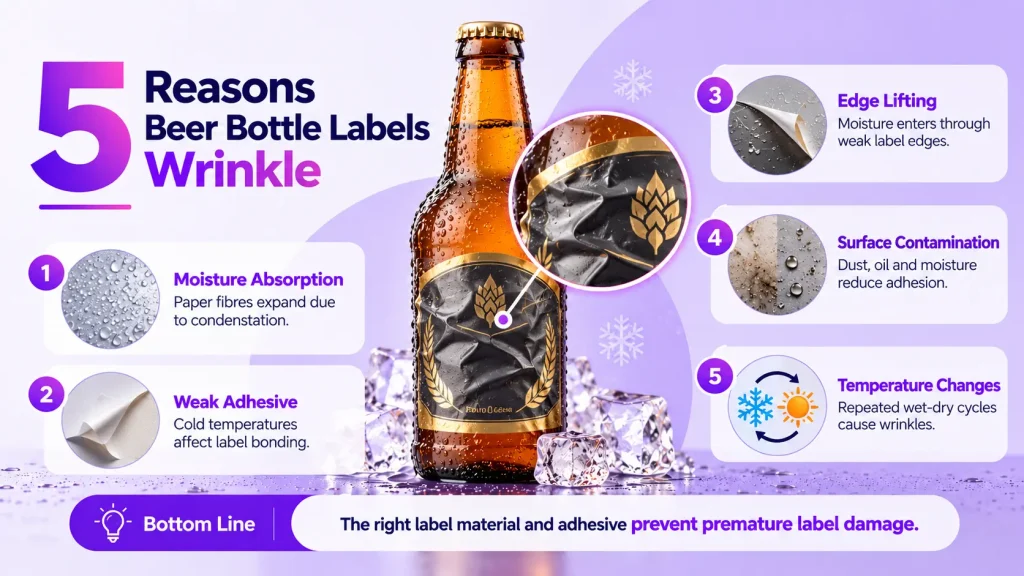
1. Paper Absorbs Moisture and Changes Dimension
Paper is hygroscopic, which means it absorbs and releases moisture from the surrounding environment.
When condensation reaches a paper label, the fibres can absorb water and expand. If the label expands while the adhesive holds parts of it tightly to the glass, the face material can no longer remain perfectly flat.
The result may be ripples, cockling, waves, or visible wrinkles.
When the bottle warms and dries again, the paper can contract. Repeated wet-dry cycles may make the visual distortion more noticeable.
2. The Adhesive Behaves Differently at Low Temperature
Adhesives are not equally effective at every temperature.
Some pressure-sensitive adhesives need a minimum application temperature to wet out properly and build bond strength. If labels are applied to bottles that are too cold, the adhesive may never develop full contact with the glass.
A label can therefore look secure immediately after application but begin lifting once condensation, refrigeration, or handling adds stress.
For cold-fill, refrigerated, or wet-use applications, the adhesive should be selected for the real application and service temperature range.
3. Condensation Can Reach Weak Label Edges
Moisture often enters at the edges first.
If the label edge is poorly bonded, contaminated, or positioned across an uneven area, condensation can move into that weak interface. Once this happens, the edge may lift, curl, or create a visible bubble.
In ice-bucket conditions, the challenge becomes more severe because the bottle can remain continuously wet.
4. Glass Surface Condition Affects Adhesion
A glass bottle may look clean and still carry residues that reduce adhesion.
Dust, oil, release agents, moisture, recycled-bottle contamination, cleaning residues, or condensation at the moment of application can interfere with the bond between adhesive and glass.
If labels are applied before the bottle surface is dry and stable, cold storage can expose the weakness later.
Wrinkling, Bubbling, and Peeling Are Different Problems
| Failure | What It Looks Like | Common Causes |
| Wrinkling / cockling | Wavy or rippled paper surface | Moisture absorption, fibre expansion, incompatible paper, repeated wet-dry cycles |
| Bubbling | Raised pockets under the label | Poor wet-out, trapped air, condensation, surface contamination |
| Edge lifting | Corners or sides begin to separate | Low adhesion, cold application, moisture ingress, unsuitable adhesive |
| Curling | Label edges visibly roll outward | Moisture imbalance, paper memory, insufficient bond strength |
| Ink scuffing | Print becomes scratched or faded | Wet abrasion, insufficient varnish or laminate, poor ink resistance |
Why Paper Labels Need the Right Wet-Strength Performance
Paper remains a popular choice for beer because it can deliver a classic, tactile, premium look. It also works well with established wet-glue and pressure-sensitive labeling systems.
But standard paper is not automatically suitable for refrigerated beverage applications.
Beer labels may need wet-strength properties so the paper maintains integrity when exposed to condensation, refrigeration, and ice-bucket conditions.
Depending on the label system, the construction may also use coatings, varnishes, laminates, or specially engineered papers to control water uptake and preserve print appearance.
Wet Glue or Self-Adhesive: Which Performs Better on Cold Beer Bottles?
Both technologies can work successfully on beer bottles when correctly specified.
The better choice depends on production speed, bottle returnability, decoration style, label size, application equipment, and wet-use performance.
Wet Glue Labels
Wet glue labels have a long history in beer and beverage packaging, especially on glass bottles.
They can be economical at high volumes and can support traditional paper label aesthetics. However, paper quality, glue formulation, bottle cleanliness, application control, and wet-strength performance are critical.
If the paper absorbs too much water or the glue system is not suited to refrigeration, the label may wrinkle or detach.
Self-Adhesive Labels
Pressure-sensitive labels offer high print quality, premium finishing options, and flexible application across multiple SKUs.
For cold and wet conditions, the face material and adhesive must be engineered for refrigeration and condensation.
A moisture-resistant film label can avoid some paper wrinkling issues, but it still requires the correct adhesive and application conditions.
Why Ice Buckets Are Harder Than Refrigerators
A refrigerator usually creates condensation after the bottle is removed into warmer air. An ice bucket can expose the label to continuous water contact.
That difference matters.
A label that survives ordinary refrigeration may still fail when partially submerged in ice water for an extended period.
For beer brands sold in bars, restaurants, hotels, events, or premium hospitality settings, ice-bucket testing should be part of label qualification.
The Application Temperature Can Decide the Final Result
One of the easiest mistakes to make is testing only service temperature and ignoring application temperature.
These are not the same thing.
A label may be designed to remain secure at low temperatures after the adhesive has fully bonded, but the same adhesive may perform poorly if applied to an already chilled or damp bottle.
Packaging teams should therefore confirm both:
- Minimum application temperature: the lowest bottle temperature at which the adhesive can be applied successfully.
- Service temperature: the temperature range the label can withstand after the bond has developed.
What Label Materials Work Best for Cold Beer Bottles?
| Label Type | Strength | Main Risk | Best Fit |
| Wet-strength paper | Traditional look with improved moisture resistance | Can still wrinkle if paper/glue system is mismatched | Classic beer bottle branding |
| Coated paper | Improved print and moisture protection | Edges can remain vulnerable | Premium paper appearance |
| Film self-adhesive label | High moisture resistance and dimensional stability | Needs correct adhesive and bottle preparation | Modern, premium, clear or durable labels |
| Shrink sleeve | Full-body coverage and strong wet-use performance | Requires shrink equipment and distortion control | High-impact or contoured bottles |

How Bottle Shape Can Make Wrinkling Worse
Even on glass, bottle geometry affects label performance.
If a label crosses a shoulder, compound curve, embossing, seam, or uneven surface, the label may already be under tension before the bottle gets cold.
Condensation and paper expansion then amplify the problem.
The safest label zone is usually a consistent cylindrical or near-flat panel where the face stock can sit without being forced into multiple directions.
Print Protection Matters Too
A label can stay attached and still fail visually.
Cold bottles are often handled with wet hands, moved in and out of coolers, rubbed against ice, or placed in metal buckets. That creates wet abrasion.
If the ink and surface protection are not designed for that environment, the label may scuff, fade, or lose gloss.
Varnish, laminate, ink chemistry, and face material should therefore be selected together rather than treated as separate decisions.
How to Test Beer Bottle Labels Before Production
A dry-room adhesion test is not enough for beer packaging.
The final label should be tested on the actual bottle under the same temperature and moisture conditions it will face in distribution and consumption.
- Apply labels to production-equivalent glass bottles.
- Use the actual planned application temperature.
- Allow the required adhesive or glue dwell time.
- Refrigerate bottles for the expected storage period.
- Remove bottles into a warm environment and observe condensation.
- Place bottles in an ice bucket for a realistic serving period.
- Repeat wet-dry temperature cycles.
- Handle bottles with wet hands and test abrasion.
- Inspect wrinkles, bubbles, edge lift, label movement, print damage, barcode readability, and visual quality.
- Test both filled and empty bottles if filling pressure or temperature can affect the pack.
A Practical Troubleshooting Guide
| Problem | What to Review |
| Label wrinkles after refrigeration | Check wet-strength paper, moisture uptake, coating, bottle contour, and glue/adhesive system. |
| Edges lift when condensation appears | Review bottle cleanliness, application temperature, edge placement, and wet-service adhesive performance. |
| Label bubbles after chilling | Check adhesive wet-out, trapped air, surface contamination, and label application pressure. |
| Print scuffs in ice bucket | Review ink system, varnish/laminate, and wet-abrasion resistance. |
| Label falls off chilled bottle | Verify minimum application temperature, service temperature, bottle dryness, and adhesive or wet-glue compatibility. |
How Jainytic Helps Improve Beer Bottle Label Performance
At Jainytic Packaging, beverage and liquor labels are selected around the full use environment, not only shelf appearance.
Jainytic supports wet glue labels, self-adhesive labels, shrink sleeves, and other labeling formats for beverage and liquor packaging.
For beer bottle applications, the specification can consider bottle material and shape, application system, refrigeration, condensation, ice-bucket exposure, paper wet strength, adhesive or glue chemistry, finishing requirements, and production volume.
This helps brands develop labels that retain their intended appearance from the labeling line to the refrigerator, bar counter, restaurant table, and consumer’s hand.
Final Thoughts: Cold Beer Should Create Condensation, Not Packaging Problems
Beer bottle labels wrinkle when cold because refrigeration changes the environment around the label.
Condensation adds moisture. Paper can expand. Adhesives can lose performance if they were applied outside the correct temperature range. Weak edges become exposed. Repeated wet handling adds mechanical stress.
The solution is not simply to use more adhesive.
The label face stock, wet strength, adhesive or glue, bottle surface, application temperature, print protection, and bottle geometry all have to work as one system.
A beer label has done its job only when it still looks intentional at the moment the bottle is opened.
Frequently Asked Questions
Wrinkling is often caused by condensation and moisture absorption. Paper fibres can expand while parts of the label remain fixed to the bottle, creating ripples or cockling.
Common causes include poor adhesive wet-out, application below the recommended temperature, condensation, bottle contamination, weak edge adhesion, or an adhesive not designed for cold and wet service.
Wet-strength or moisture-resistant papers are commonly considered for beer applications because they maintain better integrity under condensation and ice-bucket conditions. Final performance still depends on the glue or adhesive system and testing.
Film labels can offer greater dimensional stability and moisture resistance, but they still require a suitable adhesive and proper application. Paper remains popular when wet-strength performance and the correct glue system are specified.
They need an adhesive or glue system appropriate for the bottle, application temperature, refrigeration, condensation, and expected wet exposure. ‘Waterproof’ alone does not describe all required performance.
Ice buckets expose labels to prolonged direct water contact and abrasion, while refrigeration may involve mainly low temperature and later condensation. The wet exposure is usually more severe in an ice bucket.
Yes. Pressure-sensitive labels can work well on beer bottles when the face material, adhesive, bottle surface, application temperature, and wet-use conditions are correctly matched.
Test the final construction on the actual bottle through refrigeration, condensation, ice-bucket exposure, wet handling, abrasion, and repeated temperature cycles before commercial production.