
The Label Looked Perfect on the Shelf. Then the Shower Started.
A shampoo bottle can leave the factory looking flawless, survive transport, sit neatly on a retail shelf, and still fail where the consumer actually uses it: the bathroom.
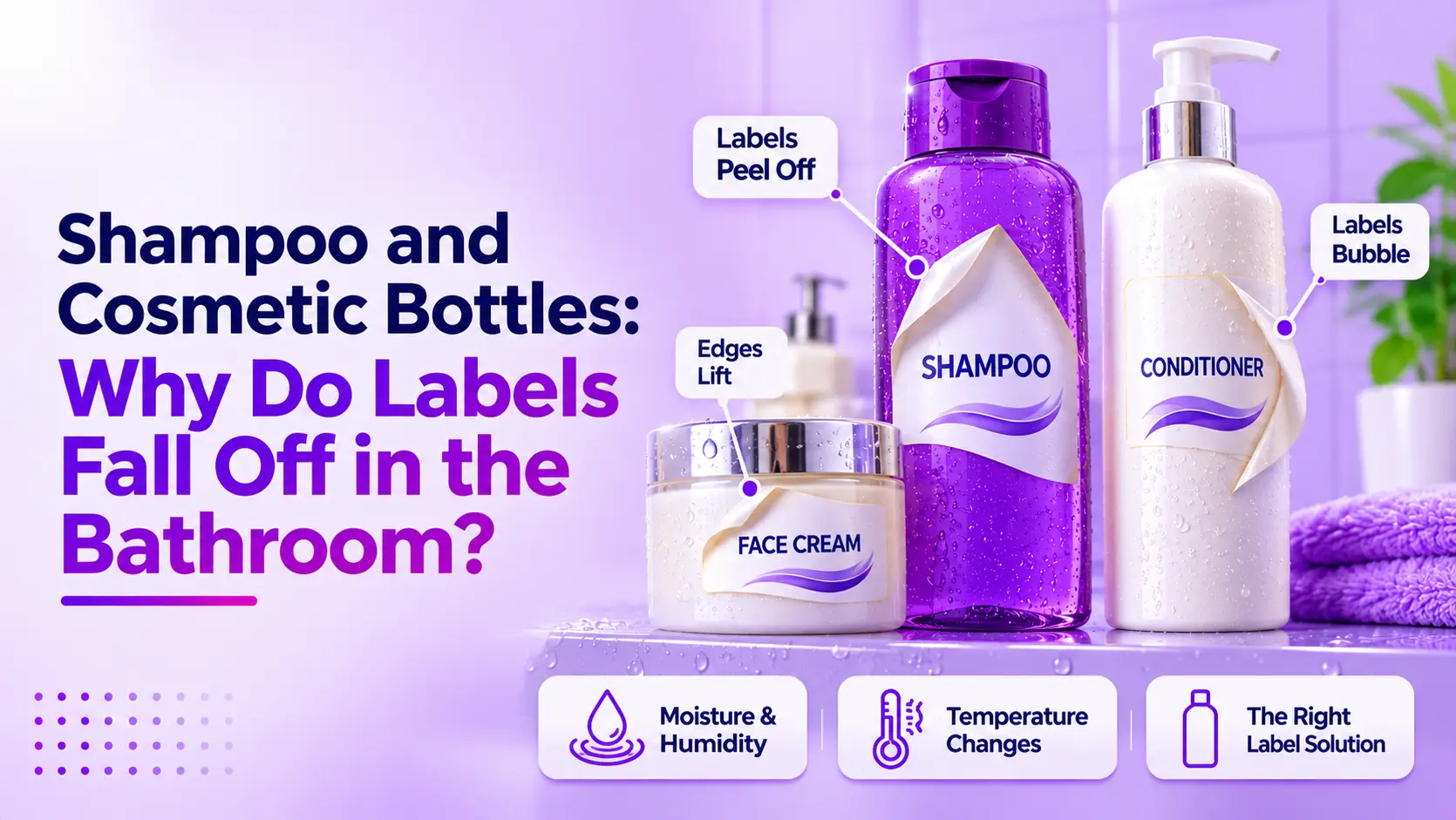
After a few showers, the corners start lifting. The label wrinkles. Moisture creeps underneath. Shampoo, conditioner, body wash, oil, or cleanser runs across the surface. The print begins to scuff, or the label slides away from the bottle.
This is not just a cosmetic problem. A failing label can make ingredients, directions, batch information, barcodes, and brand identity harder to read.
The cause is usually not one single issue. Bathroom label failure is often the result of several factors working together: water, steam, surfactants, bottle material, surface energy, flexing, adhesive chemistry, label face stock, and application conditions.
For shampoo and cosmetic bottles, the best label is not simply one that sticks at the packing line. It is one that remains attached, readable, and presentable after repeated wet handling in real consumer use.
Why Bathrooms Are So Difficult for Bottle Labels
Bathrooms expose packaging to conditions that are much harsher than a dry retail shelf.
A typical shampoo or cosmetic bottle may face repeated cycles of water exposure, humidity, steam, temperature changes, product residue, rubbing, squeezing, and drying. Each cycle can gradually weaken a label construction that was not designed for that environment.
The label may therefore fail even if it appeared to adhere correctly immediately after application.
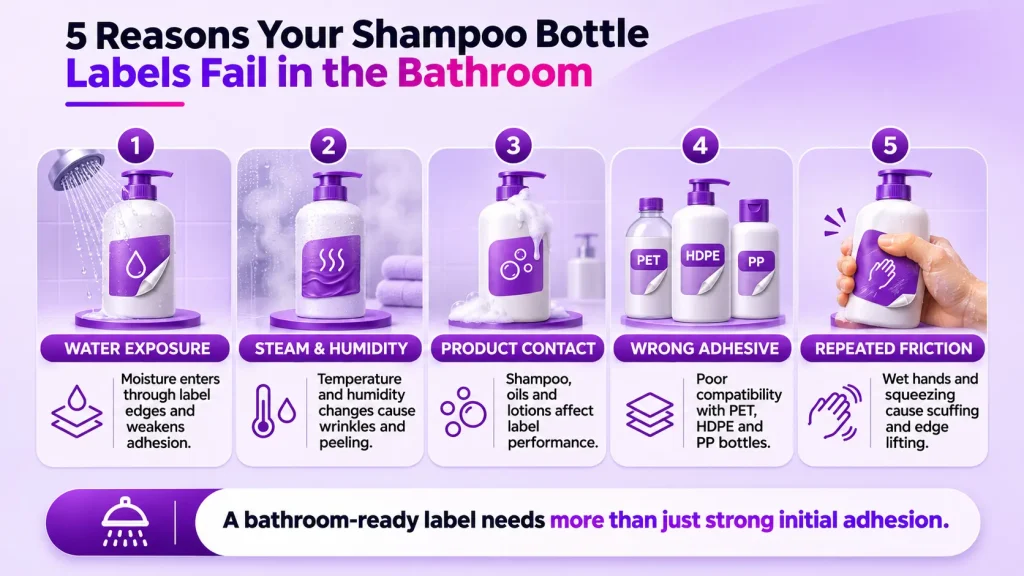
1. Water Can Attack the Label From the Edges
Water does not need to dissolve an adhesive to cause problems. Repeated wetting can enter through exposed label edges, especially when the label has already begun to lift slightly.
Once moisture reaches the adhesive interface, poor adhesion can become more visible. Paper face stocks may also absorb moisture, swell, wrinkle, or lose strength if they are not adequately protected.
This is why bathrooms often reveal weaknesses that remain hidden in dry warehouse testing.
2. Steam and Humidity Create Repeated Stress
A bathroom environment is not simply wet. It is repeatedly warm, humid, and then dry again.
These cycles can cause the bottle, adhesive, face material, inks, coatings, and laminate to expand or respond differently. If the label construction cannot tolerate the movement, edges can lift or the face material can wrinkle.
3. Shampoo and Cosmetic Formulas Can Reach the Label
Shampoo, conditioner, facial cleanser, body wash, oils, serums, lotions, and other formulations often contain surfactants, oils, fragrances, solvents, or active ingredients.
When the product runs down the outside of the pack, it can contact the label and its edges. A label that is resistant to plain water may still perform poorly when exposed to the actual formulation.
For this reason, product-resistance testing should use the real contents, not water alone.
4. Wet Hands Increase Friction and Abrasion
Consumers rarely handle bathroom products gently. Bottles are picked up with wet hands, squeezed, dropped, wiped, placed on wet shelves, and handled repeatedly over weeks.
That creates friction across the printed surface and mechanical stress at the label edges.
If print protection is insufficient, ink or varnish can scuff. If the adhesive bond is marginal, repeated handling can accelerate peeling.
The Bottle Material Matters More Than Many Brands Expect
Two bottles with the same shape can require different adhesive strategies if they are made from different plastics.
PET, HDPE, and polypropylene are common packaging materials in personal care and cosmetics, but their surfaces do not behave identically.
PET Bottles
PET generally offers a more label-friendly surface than some lower-surface-energy plastics. However, moisture, bottle curvature, product exposure, and flexing still need to be considered. A suitable film label and adhesive can provide strong bathroom performance when correctly specified.
HDPE Bottles
HDPE is widely used for shampoo, conditioner, lotion, and household or personal care bottles, but it has relatively low surface energy. This makes it harder for some general-purpose adhesives to wet out and develop a strong bond. For HDPE bottles, an adhesive formulated for low-surface-energy plastics is often essential.
Polypropylene Bottles
Polypropylene also presents a low-surface-energy surface. Labels can perform well, but adhesive compatibility should be tested on the exact bottle rather than assumed from the resin name alone.
Why Paper Labels Often Struggle in Bathrooms
Paper can create a premium, natural, or tactile appearance, but an unprotected paper label is usually a higher-risk choice for repeatedly wet bathroom packaging.
The label may absorb moisture, lose stiffness, wrinkle, tear, or show staining. Even when the adhesive remains attached, the printed face can deteriorate.
Paper can still be used when the construction includes appropriate barrier coatings or lamination and the final pack is fully tested. But for high-moisture applications, film labels are often a safer starting point.
Why Film Labels Are Often Better for Shampoo and Cosmetic Bottles
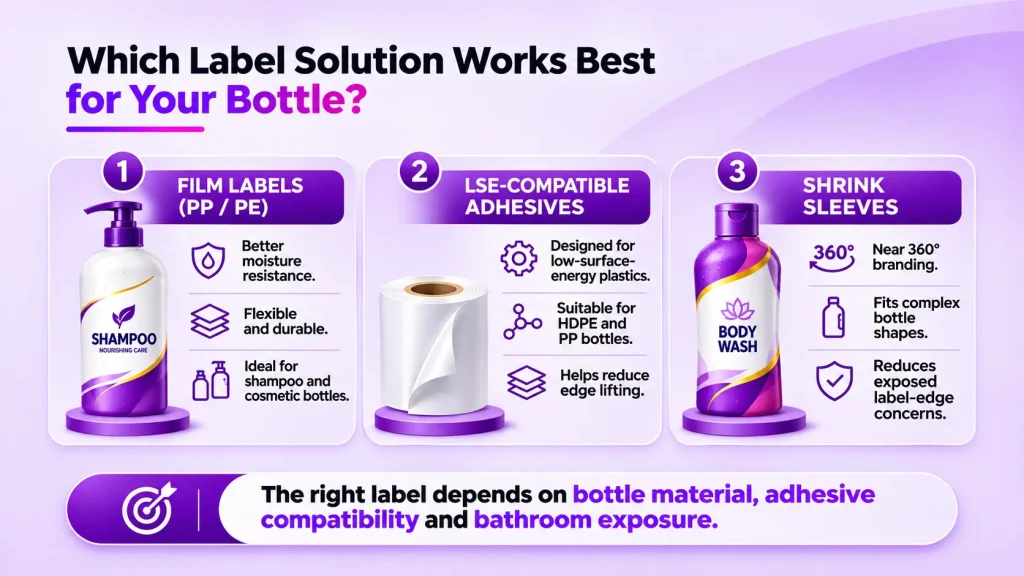
Film face stocks such as PP or PE are commonly considered for bathroom products because they can provide stronger moisture resistance and better durability than unprotected paper.
They can also flex more effectively with squeezable bottles and support clear, white, matte, gloss, metallic, or transparent visual effects.
However, choosing a film face stock does not automatically solve label failure. The adhesive still has to match the bottle surface, and the print system still has to tolerate the product and use environment.
The Adhesive Is the Hidden Performance Layer
Consumers see the artwork. Packaging teams often focus on the face material. But the adhesive is the layer that determines whether the label remains attached.
For shampoo and cosmetic bottles, adhesive selection should consider:
- Bottle resin: PET, HDPE and PP can require different adhesive behaviour.
- Surface energy: Low-surface-energy plastics may need specially formulated adhesives.
- Application temperature: The adhesive must develop contact at the temperature used during labeling.
- Wet-use exposure: Repeated humidity, splashing and condensation should not undermine the bond.
- Product contact: The adhesive and label edge should tolerate likely contact with the actual formula.
- Bottle flexing: Squeezable bottles create movement that can stress a rigid label or weak adhesive interface.
- Dwell time: Some adhesives build final bond strength over time, so immediate tack and ultimate adhesion are not the same thing.
Common Label Failures on Shampoo and Cosmetic Bottles
Edge lifting
Usually starts at corners or along an exposed edge. It can result from low adhesion, bottle curvature, contamination, flexing, or water ingress.
Bubbling
Can occur when the label does not conform properly, when air is trapped during application, or when the bottle surface and label construction respond differently to temperature or flexing.
Wrinkling
Often linked to moisture-sensitive face materials, bottle movement, or a label that is too rigid for the application.
Sliding or label movement
May indicate insufficient adhesive hold, contamination, product contact, or unsuitable application conditions.
Ink scuffing
The label may remain attached while the printed surface becomes unreadable because inks, varnish, or laminate were not designed for abrasion or product exposure.
Label whitening or hazing
Clear labels and overlaminates can show visual defects if moisture, adhesive selection, or application conditions are not controlled.
Why Label Edges Matter So Much in Wet Environments
In bathrooms, failure often begins at the edge rather than in the centre of the label.
If an edge crosses a sharp curve, shoulder, recess, embossed feature, or area that flexes during squeezing, the label is already under mechanical stress. Water and product residue then have an easier path into that weak point.
Label dimensions and die shape should therefore be designed around the bottle geometry.
A slightly smaller label positioned on a stable panel can sometimes perform better than a larger label forced across difficult curves.
Could Shrink Sleeves Be a Better Option?
For some shampoo and cosmetic bottles, yes.
Shrink sleeves can provide near 360-degree decoration and conform around complex bottle shapes without depending on pressure-sensitive adhesive across the main decorated area.
This can make them useful for contoured packs, full-body branding, and applications where exposed label edges are a concern.
However, shrink sleeves require suitable sleeve film, artwork distortion control, and a consistent heat-shrink process. They are not automatically better for every bottle.
For standard bottle shapes and flexible SKU management, a well-engineered self-adhesive film label may still be the more practical solution.
What Label Construction Works Best in the Bathroom?
| Application Need | Recommended Starting Point | Why | Watch For |
| Standard shampoo bottle | Film self-adhesive label | Moisture resistance and flexible production | Adhesive compatibility and bottle curvature |
| HDPE squeeze bottle | Flexible film + LSE-compatible adhesive | Better fit for low-surface-energy plastic and flexing | Edge lift and squeeze movement |
| Premium cosmetic bottle | Film or protected specialty label | Supports high-quality finishes | Product resistance and wet handling |
| Highly contoured bottle | Shrink sleeve | Conforms around complex geometry | Heat profile and artwork distortion |
| Full-body branding | Shrink sleeve | Near 360-degree graphic coverage | Material selection and recycling compatibility |
| Dry-use secondary pack | Paper may be possible | Supports tactile or premium aesthetics | Humidity and splash exposure |
How to Test a Bathroom Label Before Launch
The most important test is not whether the label sticks immediately after application. It is whether it survives the way consumers will use the product.
A practical qualification program should use production-equivalent bottles, labels, filling conditions, and the real product formula.
- Apply labels and allow the recommended dwell time before testing.
- Expose the bottle to repeated water spray or immersion conditions relevant to use.
- Cycle the pack through warm, humid, and dry conditions.
- Apply the actual shampoo, conditioner, oil, cleanser, or cosmetic formula to the label and edges.
- Handle the bottle repeatedly with wet hands.
- Squeeze or flex the bottle if consumers will do so.
- Check edge lift, bubbling, wrinkling, label movement, print scuffing, barcode readability, and visual clarity.
- Repeat testing after storage, transport simulation, and temperature cycling where relevant.
What Packaging Teams Should Ask Before Approving the Label
- What plastic is the bottle made from?
- Is the bottle rigid or squeezable?
- Does the label cross a curve, shoulder, recess, or embossed area?
- Will the product regularly run over the label?
- Will the bottle stay inside a shower or high-humidity bathroom?
- Does the artwork require clear, white, matte, metallic, or textured material?
- Will the label be applied manually or automatically?
- What is the expected shelf life and in-use life?
- Does the pack need a separate tamper-evident feature?
- Has the final construction been tested on the real bottle with the real formula?
How Jainytic Helps Improve Label Performance for Personal Care Packaging
At Jainytic Packaging, shampoo and cosmetic labels are approached as part of the complete pack rather than as a printed sticker selected in isolation.
Jainytic can support self-adhesive labels, shrink sleeves, multilayer labels and rigid packaging solutions across personal care and cosmetic applications.
The right specification can be selected by considering bottle resin, surface characteristics, label panel, moisture exposure, product chemistry, bottle flexing, desired finish, application method, and production volume.
For bathroom products, this application-first approach is important because visual quality at the packing line is only the beginning. The label still has to perform after repeated wet use in the consumer’s home.
Final Thoughts: Bathroom-Proof Labeling Starts Before the Bottle Reaches the Bathroom
Labels do not fall off shampoo and cosmetic bottles simply because bathrooms are wet.
They fail when the label construction, adhesive, bottle surface, bottle geometry, product formula, or application process is not matched to the environment.
For many shampoo and cosmetic bottles, a moisture-resistant film label with the correct adhesive is a strong starting point. For highly contoured packs or full-body decoration, shrink sleeves can be an effective alternative.
The key is to test the complete packaging system under realistic conditions.
A label that survives the bathroom protects more than the artwork. It protects product information, brand presentation, and the consumer experience.
Frequently Asked Questions
Common causes include water exposure, steam, low-surface-energy bottle plastics, unsuitable adhesive, bottle flexing, product residue, and label edges positioned across difficult curves.
Film labels such as PP or PE are often strong choices because they can provide moisture resistance and durability. The correct adhesive still depends on the bottle material and application conditions.
Not always. The label also needs resistance to the actual product formula, wet handling, abrasion, bottle flexing, humidity, and the bottle surface itself.
HDPE has low surface energy, which can make bonding difficult for general-purpose adhesives. An adhesive designed for low-surface-energy plastics is often required.
They can be used in some applications, especially with suitable coatings or lamination, but unprotected paper is generally more vulnerable to moisture, wrinkling, tearing, and staining.
They can be better for highly contoured bottles, full-body branding, and applications where exposed pressure-sensitive label edges are undesirable. Standard bottle shapes may still be better served by a well-designed self-adhesive film label.